Half Dome Cables and Trail

The National Park Service has not published a boundary polygon for this district; the map shows the listed properties inside it and the district's reference point.
Why it's listed
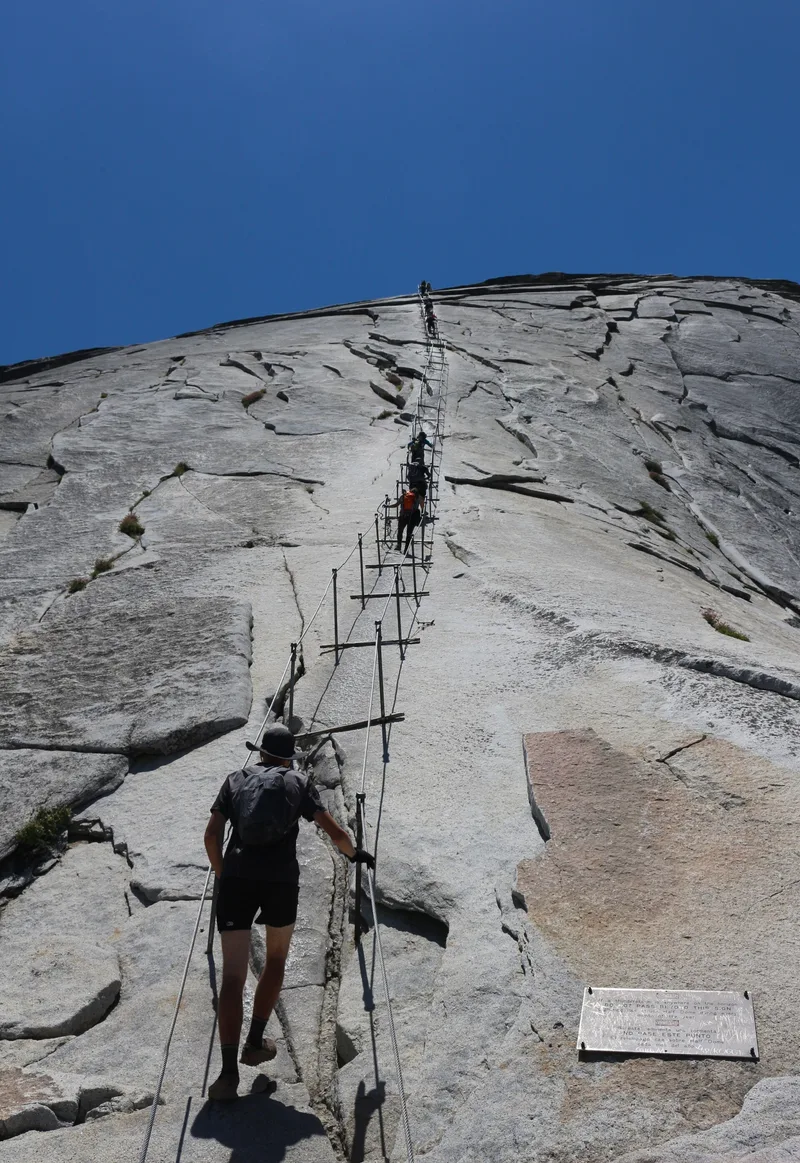
Half Dome Cables and Trail is a historic climbing route and present-day trail that climbs the eastern side of Half Dome in Yosemite National Park. It runs roughly 3,800 feet in three segments: the Sub Dome switchbacks, a saddle of exposed bedrock, and a pair of steel cables over slopes that sometimes exceed 50 degrees. George Anderson first reached the summit in 1875 using drilled holes and eyebolts. In 1919 the Sierra Club built the dry-laid granite steps and retaining walls and installed the cables. Contributing resources are the trail alignment, the stonework, and the ruins of a memorial arch honoring Anderson. The current cables and stanchions date from 1984 and are counted as non-contributing but compatible, since they follow the original design and alignment. The route is considered locally significant for recreation, transportation, its association with Anderson, and its early use of specialized climbing techniques. The period of significance runs from 1875 to 1919.
Machine-generated summary. This summary was generated by a language model from the official nomination document and has not been reviewed line by line by an editor. It may contain errors. Check the source document before relying on any detail. Source: nomination document (PDF) · catalog entry. Generated October 2026 (model claude-sonnet-5-5, prompt v1.0-2026-10-29).
| Period of significance | 1875 - 1919 |
|---|---|
| Styles | Other: Naturalistic Landscape Design |
| Areas of significance | Entertainment/Recreation, Landscape Architecture |
| Acreage | 6.3 |
| Boundary source | not published |
| Full listing page | Half Dome Cables and Trail (property record) |
What listing means for this property
This is a historic district. Buildings within its boundary are either contributing (they add to the district's significance) or non-contributing. Owners of contributing income-producing buildings can claim the 20% federal rehabilitation tax credit; homeowners should look at state credits. National Register districts impose no design review by themselves; a local historic district ordinance, if one exists, does (the difference explained).
General information, not legal or tax advice. Rules change; confirm with your State Historic Preservation Office or a qualified adviser.