Fox Fullerton Theatre Complex

The National Park Service has not published a boundary polygon for this district; the map shows the listed properties inside it and the district's reference point.
Why it's listed
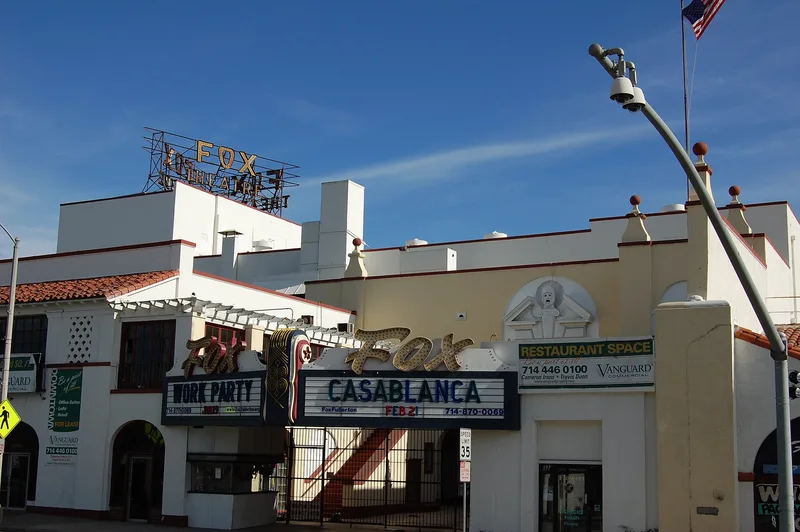
Occupying a corner in the center of downtown Fullerton, this theatre complex combines a movie house, a garden café and retail space. C. Stanley Chapman, son of the city's first mayor, built it in 1924-25 for $300,000. Meyer and Holler, Inc. constructed it from designs by Raymond M. Kennedy, who drew on Italian Renaissance models. A courtyard entrance includes a wall fountain, a large cast stone urn and a Greek-style theatrical mask with lit eyes. Inside, six canvas murals on California history by A. B. Heinsbergen and Company, plus stenciled work by John Gabriel Beckman, decorate the auditorium. In 1929 a Spanish Colonial Revival service station designed by Stiles O. Clements was added. The complex was Orange County's first movie palace and is the only surviving suburban courtyard theatre by its builder. Closed in 1987, it deteriorated for years before a community nonprofit took control in 2005 to begin restoration. Despite alterations such as 1950s marquee changes, it retains much of its integrity.
Machine-generated summary. This summary was generated by a language model from the official nomination document and has not been reviewed line by line by an editor. It may contain errors. Check the source document before relying on any detail. Source: nomination document (PDF) · catalog entry. Generated October 2026 (model claude-sonnet-5-5, prompt v1.0-2026-10-29).
| Styles | Late 19th and 20th Century Revivals/Italian Renaissance; Late 19th and 20th Century Revivals/Spanish Colonial Revival |
|---|---|
| Areas of significance | Architecture, Art |
| Acreage | 0.7 |
| Boundary source | not published |
| Full listing page | Fox Fullerton Theatre Complex (property record) |
What listing means for this property
This is a historic district. Buildings within its boundary are either contributing (they add to the district's significance) or non-contributing. Owners of contributing income-producing buildings can claim the 20% federal rehabilitation tax credit; homeowners should look at state credits. National Register districts impose no design review by themselves; a local historic district ordinance, if one exists, does (the difference explained).
General information, not legal or tax advice. Rules change; confirm with your State Historic Preservation Office or a qualified adviser.