Fort Point National Historic Site

The National Park Service has not published a boundary polygon for this district; the map shows the listed properties inside it and the district's reference point.
Why it's listed
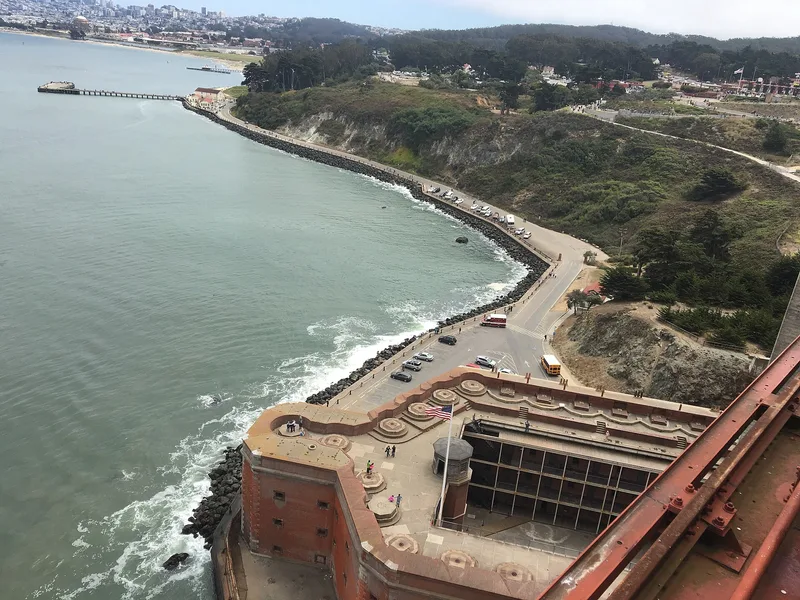
Fort Point is a four-story masonry fort on the promontory at the northern end of the San Francisco Peninsula, facing the Golden Gate. Built in 1853 by the U.S. Army Engineers to protect San Francisco Harbor, it is made of brick trimmed with granite and was designed after Fort Sumter. Some walls are 36 feet thick. A courtyard is surrounded on three sides by galleries of tiered brick arches, and spiral granite stairways rise in three towers. An octagonal metal lighthouse sits atop the northwest tower. The fort held 149 guns in four tiers, and rainwater from the roof was channeled to a double cistern below. The site had earlier defenses, including the Spanish adobe Castillo de San Joaquin of 1794. The fort was declared obsolete in 1905, its batteries were abandoned in 1914, and the Golden Gate Bridge has overshadowed it since 1937. It was renamed Fort Winfield Scott after 1882 and became a national historic site in 1970.
Machine-generated summary. This summary was generated by a language model from the official nomination document and has not been reviewed line by line by an editor. It may contain errors. Check the source document before relying on any detail. Source: nomination document (PDF) · catalog entry. Generated October 2026 (model claude-sonnet-5-5, prompt v1.0-2026-10-29).
| Styles | Federal |
|---|---|
| Areas of significance | Military, Architecture, Maritime History |
| Acreage | 29 |
| Boundary source | not published |
| Full listing page | Fort Point National Historic Site (property record) |
What listing means for this property
This is a historic district. Buildings within its boundary are either contributing (they add to the district's significance) or non-contributing. Owners of contributing income-producing buildings can claim the 20% federal rehabilitation tax credit; homeowners should look at state credits. National Register districts impose no design review by themselves; a local historic district ordinance, if one exists, does (the difference explained).
Noted as vacant in the nomination. Nomination documents can be decades old; current status may differ. If you are considering buying an empty listed property, read the due-diligence checklist.
General information, not legal or tax advice. Rules change; confirm with your State Historic Preservation Office or a qualified adviser.