Court at 940-948 North Raymond Avenue

The National Park Service has not published a boundary polygon for this district; the map shows the listed properties inside it and the district's reference point.
Why it's listed
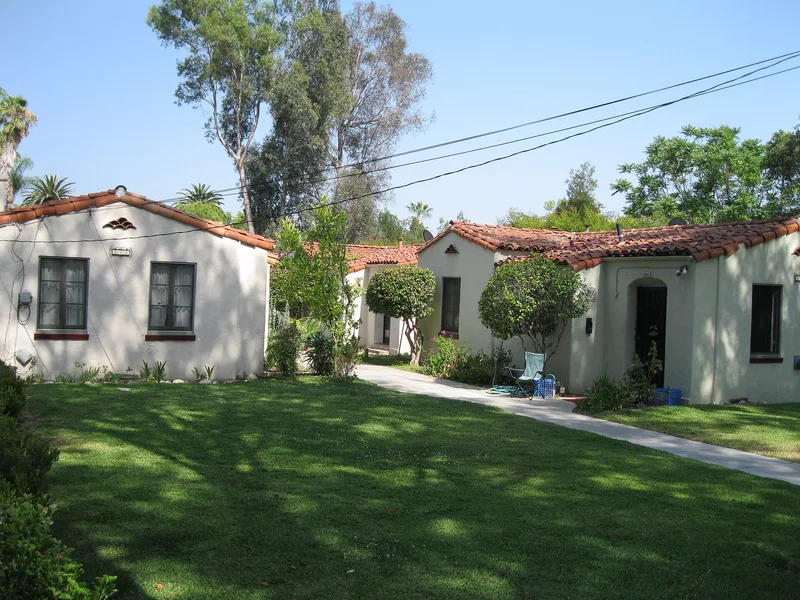
Five small houses arranged in two rows around a central landscaped yard make up this bungalow court on a narrow 70-foot lot on North Raymond Avenue in Pasadena. Architect N. S. Bungus designed it in 1929 for owner H. R. Pompeyon, and each bungalow cost $2,000 to build. Every unit has an L-shaped plan, stucco walls, a gabled clay tile roof, multi-pane casement windows with brick sills, and a recessed arched entry with a wrought iron lantern and inlaid ceramic tile. Canvas awnings shade the windows facing the street, and two flat-roofed garages sit at the rear. The court was listed for its architecture. It is considered one of the most intact and attractive bungalow courts in North Pasadena, and its authentic Spanish Colonial Revival detailing is richer than that of the plainer, low-cost courts typical of the period. It still serves as multiple dwellings.
Machine-generated summary. This summary was generated by a language model from the official nomination document and has not been reviewed line by line by an editor. It may contain errors. Check the source document before relying on any detail. Source: nomination document (PDF) · catalog entry. Generated October 2026 (model claude-sonnet-5-5, prompt v1.0-2026-10-29).
| Period of significance | 1929 |
|---|---|
| Styles | Spanish Colonial Revival |
| Areas of significance | Architecture |
| Acreage | 0.9 |
| Boundary source | not published |
| Full listing page | Court at 940-948 North Raymond Avenue (property record) |
What listing means for this property
This is a historic district. Buildings within its boundary are either contributing (they add to the district's significance) or non-contributing. Owners of contributing income-producing buildings can claim the 20% federal rehabilitation tax credit; homeowners should look at state credits. National Register districts impose no design review by themselves; a local historic district ordinance, if one exists, does (the difference explained).
General information, not legal or tax advice. Rules change; confirm with your State Historic Preservation Office or a qualified adviser.