Court at 1274-1282 North Raymond Avenue

The National Park Service has not published a boundary polygon for this district; the map shows the listed properties inside it and the district's reference point.
Why it's listed
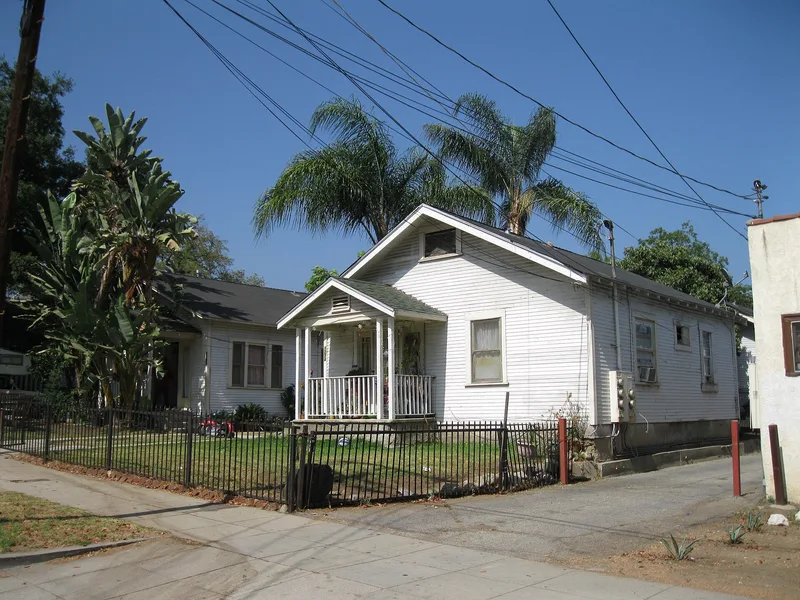
Five small one-story bungalows arranged in a U-shaped plan make up this court on North Raymond Avenue in Pasadena. Built in 1924-25, it has gabled roofs, clapboard siding, wood double-hung windows and raised concrete foundations. Two parallel walkways lead back to the rear unit. The front units and the rear unit have offset entry porticos with paired wood posts, while the center units have small shed-roof canopies. The design mixes simplified Colonial Revival features, seen in the classical porticos, with Craftsman details such as exposed rafters and wide eave overhangs. Karl Valentine served as owner, architect and contractor, and he also built a similar court on North Mar Vista Avenue in 1927. The court was one of many built along this stretch of Raymond Avenue after the city adopted its first zoning laws permitting such housing. It is recognized for architecture as one of Pasadena's best examples of the enclosed bungalow court form, and it remains in residential use.
Machine-generated summary. This summary was generated by a language model from the official nomination document and has not been reviewed line by line by an editor. It may contain errors. Check the source document before relying on any detail. Source: nomination document (PDF) · catalog entry. Generated October 2026 (model claude-sonnet-5-5, prompt v1.0-2026-10-29).
| Period of significance | 1924-1925 |
|---|---|
| Styles | Colonial Revival |
| Areas of significance | Architecture |
| Acreage | 0.9 |
| Boundary source | not published |
| Full listing page | Court at 1274-1282 North Raymond Avenue (property record) |
What listing means for this property
This is a historic district. Buildings within its boundary are either contributing (they add to the district's significance) or non-contributing. Owners of contributing income-producing buildings can claim the 20% federal rehabilitation tax credit; homeowners should look at state credits. National Register districts impose no design review by themselves; a local historic district ordinance, if one exists, does (the difference explained).
General information, not legal or tax advice. Rules change; confirm with your State Historic Preservation Office or a qualified adviser.