Clarke Estate

The National Park Service has not published a boundary polygon for this district; the map shows the listed properties inside it and the district's reference point.
Why it's listed
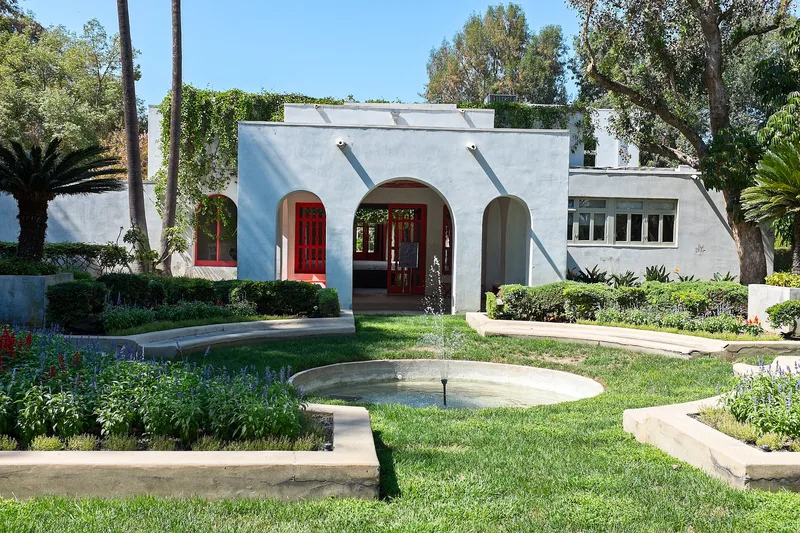
Built in 1921 on former orange grove land in Santa Fe Springs, this two-story residence was designed by architect Irving Gill for Chauncey and Marie Clarke. The house is a U-shaped block of poured-in-place reinforced concrete, with plain walls and cubic masses outside and an interior courtyard closed on one side by a porte cochere. The courtyard is more ornate, with cast concrete window surrounds, Chinese wood balcony railings, a Mayan-pattern magnesite floor and leaf impressions in the wall coating. These details are attributed to Mrs. Clarke's influence. The 3.11-acre grounds also hold a fountain, a wooden orange packing house that predates the residence, and a decorative pool. The estate is considered significant as the best preserved major residence from Gill's mature period, since his Dodge and Scripps houses were lost or heavily altered. The Clarkes lived here only from 1921 to 1923, after oil was discovered nearby.
Machine-generated summary. This summary was generated by a language model from the official nomination document and has not been reviewed line by line by an editor. It may contain errors. Check the source document before relying on any detail. Source: nomination document (PDF) · catalog entry. Generated October 2026 (model claude-sonnet-5-5, prompt v1.0-2026-10-29).
| Period of significance | 1921 |
|---|---|
| Styles | Mission Reduction (reductive Mission Revival) - Irving Gill |
| Areas of significance | Architecture |
| Acreage | 3.1 |
| Boundary source | not published |
| Full listing page | Clarke Estate (property record) |
What listing means for this property
This is a historic district. Buildings within its boundary are either contributing (they add to the district's significance) or non-contributing. Owners of contributing income-producing buildings can claim the 20% federal rehabilitation tax credit; homeowners should look at state credits. National Register districts impose no design review by themselves; a local historic district ordinance, if one exists, does (the difference explained).
General information, not legal or tax advice. Rules change; confirm with your State Historic Preservation Office or a qualified adviser.