Dresbach-Hunt-Boyer House
Also known as: Boyer House

Why it's listed
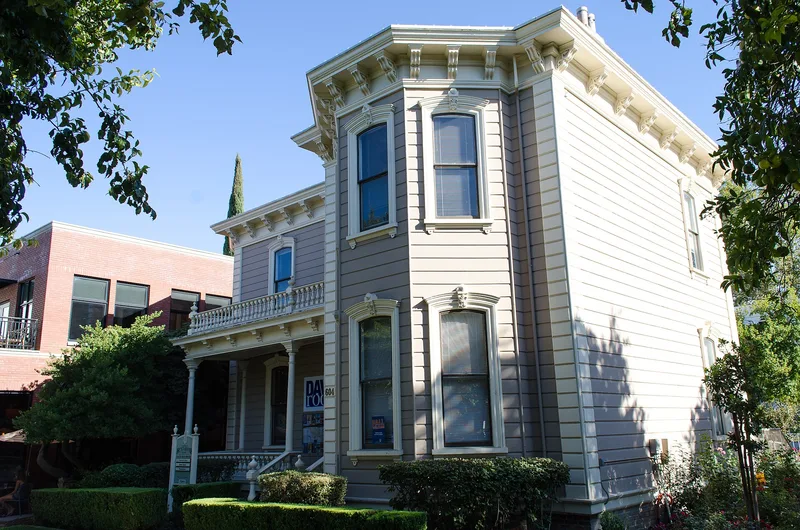
Built around 1871 to 1875, this twelve-room redwood house at 604 Second Street in Davis was the home of William Dresbach, a German-born merchant and Davisville's first postmaster. It combines Italianate severity with Stick-style horizontal siding, carved brackets, rounded window cornices, two polygonal bays, and a covered porch with a small balcony. Behind it stands a two-story water tower that originally served as a windmill. The house sits on four city lots with orange, lemon, peach, apricot and plum trees, planted largely by John Hunt, whose family owned the property from 1899. Patricio Vaca and Cirilo Zuniga, two pioneers of Spanish descent, did much of the intricate woodwork. The nomination describes it as the only standing example of Northern California Stick-Italianate architecture of the 1870s in Davis, and as a reminder of the town's early pioneer character. Alterations include a 1930s garage and an enclosed back porch.
Significance in brief: The nomination calls it Davis' only standing example of Northern California Stick-Italianate architecture of the 1870s. It was built for William Dresbach, a prominent early merchant and Davisville's first postmaster, and reflects the lifestyle of one of the town's wealthiest early citizens. As one of the first residences in the new town, it recalls the pioneer community.
Machine-generated summary. This summary was generated by a language model from the official nomination document and has not been reviewed line by line by an editor. It may contain errors. Check the source document before relying on any detail. Source: nomination document (PDF) · National Archives catalog entry. NRHP reference 76000540, listed September 13, 1976. Summary generated October 2026 (model claude-sonnet-5-5, prompt v1.0-2026-10-29, confidence high).
Key facts
| Address | 604 2nd St., Davis |
|---|---|
| County | Yolo County |
| Listed | September 13, 1976 |
| Reference number | 76000540 |
| Resource type | Building |
| Period of significance | circa 1871-1875 |
| Architect / builder | Unknown; probably no architect. Woodwork by Patricio Vaca and Cirilo Zuniga. |
| Architectural style | Stick-Italianate Victorian |
| Areas of significance | Exploration/Settlement, Architecture |
| Level of significance | Local |
| Status (as stated in the nomination) | Private residence in good condition and essentially unchanged since the 1870s; the owner filed a demolition application in April 1976, and the city planned a bond election to purchase it. |
| Acreage | 0.6 |
| Coordinates | 38.54317, -121.74059 (NPS GIS) |
What listing means for this property
National Register listing is honorary for a privately owned home: it does not by itself restrict what an owner may do with their own money, and it does not require public access. Restrictions come from local landmark or historic-district ordinances, which are separate (how they differ).
Owner-occupied houses are not eligible for the 20% federal rehabilitation tax credit, which applies to income-producing buildings, but many states offer credits for homeowners. Listing also opens the door to preservation easements and to buying a plaque. Start with what listing means for homeowners, renovating a listed house and selling one.
General information, not legal or tax advice. Rules change; confirm with your State Historic Preservation Office or a qualified adviser.
Sources and further reading
- National Park Service, National Register of Historic Places database (snapshot May 2026), reference 76000540.
- Nomination form (PDF, National Archives) — catalog entry
- Wikipedia article (used for cross-checking only; text not reproduced here)
- Wikidata Q14681864
- This listing as JSON
Last updated October 2026. Found an error? See the editorial policy for how to report it.