Soda Springs Cabin
Also known as: Soda Springs Enclosure; John Lembert Homestead

Why it's listed
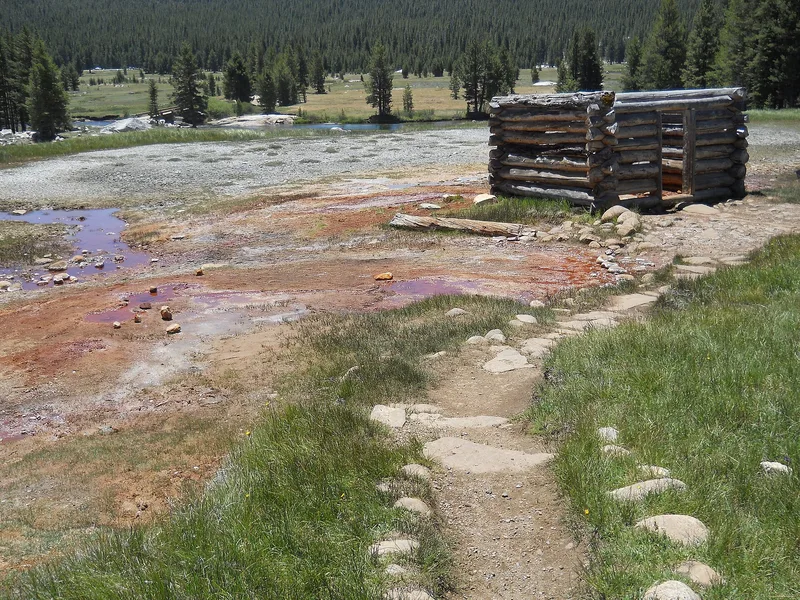
Soda Springs Cabin is a small log structure at Tuolumne Meadows in Yosemite National Park, built around 1889 by John Baptiste Lembert directly over a bubbling soda spring. Measuring nine by eleven feet, with no windows and a dirt floor, it was probably a spring house meant to keep grazing stock from fouling the water rather than a dwelling. Today the peeled, weathered walls stand about seven feet high with V-notched corners, and the roof and chinking are gone. Lembert filed a claim to 160 acres in 1885 and received title by patent in 1895, making him the first white settler of the Tuolumne Meadows area. He also guided entomologist Harrison Dyar and collected specimens for federal agencies, the Smithsonian Institution and the University of California; a moth was named for him. The cabin is the last remaining structure linked to him and was listed for its associations with early settlement and science.
Significance in brief: It is the last remaining structure of the homestead of John Baptiste Lembert, the first white settler of the Tuolumne Meadows region. It has local significance in exploration and settlement, and in science through Lembert's entomological collecting and his work as a guide and naturalist.
Machine-generated summary. This summary was generated by a language model from the official nomination document and has not been reviewed line by line by an editor. It may contain errors. Check the source document before relying on any detail. Source: nomination document (PDF) · National Archives catalog entry. NRHP reference 79000282, listed April 19, 1979. Summary generated October 2026 (model claude-sonnet-5-5, prompt v1.0-2026-10-29, confidence high).
Key facts
| Address | SW of Lee Vining, Lee Vining |
|---|---|
| County | Tuolumne County |
| Listed | April 19, 1979 |
| Reference number | 79000282 |
| Resource type | Building |
| Period of significance | c. 1885-1889 |
| Architect / builder | John Baptiste Lembert |
| Criteria |
|
| Areas of significance | Exploration/Settlement, Science |
| Level of significance | Local |
| Status (as stated in the nomination) | Deteriorated and unaltered: walls are about eight logs high, the roof is gone and the chinking no longer exists. The park management plan proposes no action, leaving it in a state of 'benign neglect'. |
| Acreage | 0.9 |
| Coordinates | 37.87872, -119.36664 (NPS GIS) |
What listing means for this property
National Register listing is honorary for a privately owned home: it does not by itself restrict what an owner may do with their own money, and it does not require public access. Restrictions come from local landmark or historic-district ordinances, which are separate (how they differ).
Owner-occupied houses are not eligible for the 20% federal rehabilitation tax credit, which applies to income-producing buildings, but many states offer credits for homeowners. Listing also opens the door to preservation easements and to buying a plaque. Start with what listing means for homeowners, renovating a listed house and selling one.
Noted as vacant in the nomination. Nomination documents can be decades old; current status may differ. If you are considering buying an empty listed property, read the due-diligence checklist.
General information, not legal or tax advice. Rules change; confirm with your State Historic Preservation Office or a qualified adviser.
Sources and further reading
- National Park Service, National Register of Historic Places database (snapshot May 2026), reference 79000282.
- Nomination form (PDF, National Archives) — catalog entry
- Wikipedia article (used for cross-checking only; text not reproduced here)
- Wikidata Q7553192
- This listing as JSON
Last updated October 2026. Found an error? See the editorial policy for how to report it.