St. James Square Historic District
Also known as: St. James Park

Why it's listed
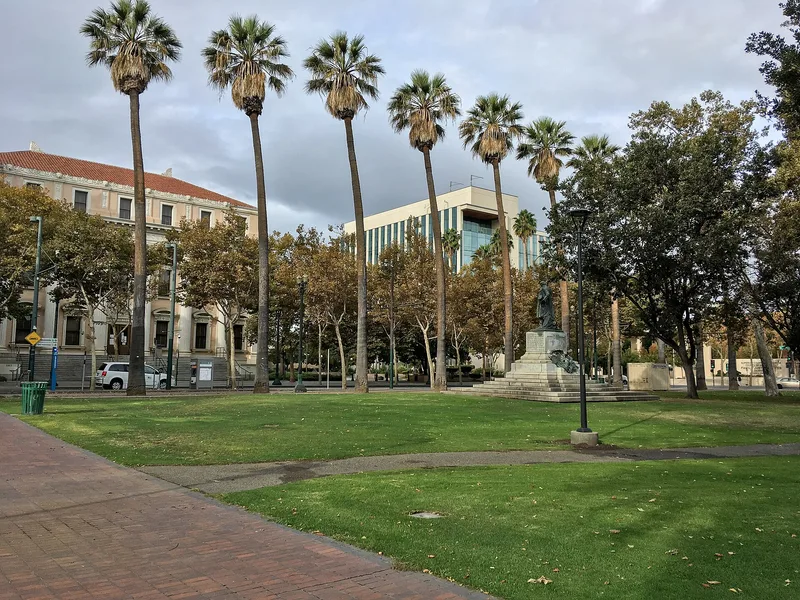
St. James Square is a downtown San Jose district built around a two-block public park first reserved in the 1848 city survey by Charles S. Lyman. Around the park stand two courthouses, a post office, three churches, three private clubs and a commercial building, mostly dating from 1863 to the 1930s. Notable examples include the 1866 Santa Clara County Courthouse by Levi Goodrich, the 1863 Carpenter Gothic Trinity Episcopal Church, the 1893 Sainte Claire Club by A. Page Brown, the 1904 First Church of Christ, Scientist by Willis Polk, and the 1924 Scottish Rite Temple. The park holds monuments to President McKinley and General Naglee and kept its diagonal walkway pattern. The district was listed for its architecture, landscape and community planning value. It is described as the city's best remaining gathering of nineteenth and early twentieth century civic, religious and social buildings around a central open space. A 1960s courthouse tower and community center are classed as nonconforming.
Significance in brief: The nomination presents the district as the best remaining example in San Jose of late nineteenth and early twentieth century buildings gathered around an identifiable core. It combines an urban park with courthouses, churches and clubs in a range of revival styles. These buildings give residents a tangible sense of time and place.
Machine-generated summary. This summary was generated by a language model from the official nomination document and has not been reviewed line by line by an editor. It may contain errors. Check the source document before relying on any detail. Source: nomination document (PDF) · National Archives catalog entry. NRHP reference 79000546, listed November 27, 1979. Summary generated October 2026 (model claude-sonnet-5-5, prompt v1.0-2026-10-29, confidence medium).
Key facts
| Address | Roughly bounded by N. 1st, N. 4th, E. St. James, and E. St. John Sts., San Jose |
|---|---|
| County | Santa Clara County |
| Listed | November 27, 1979 |
| Reference number | 79000546 |
| Resource type | District |
| Period of significance | 1800-1899, 1900- |
| Architect / builder | Willis Polk; A. Page Brown; Carl Werner; G.W. Page; John W. Hammond; Ralph Wyckoff; Levi Goodrich; Frederick Law Olmstead (park, 1868) |
| Architectural style | Mixed styles: Gothic Revival (Carpenter Gothic), Greek Revival, Spanish Colonial Revival, Romanesque Revival, Neo-Classical, Renaissance Revival, Mediterranean (Mission Revival), International |
| Areas of significance | Community Planning and Development, Landscape Architecture, Exploration/Settlement, Architecture |
| Level of significance | Local |
| Status (as stated in the nomination) | Condition rated good. Most buildings remain in use, including the courthouse and Trinity Episcopal Church. The Christ Scientist church serves as a children's theater rehearsal hall, and the Scottish Rite Temple was being adapted as a private athletic club. |
| Acreage | 7.7 |
| Coordinates | 37.33900, -121.89137 (NPS GIS) |
What listing means for this property
This is a historic district. Buildings within its boundary are either contributing (they add to the district's significance) or non-contributing. Owners of contributing income-producing buildings can claim the 20% federal rehabilitation tax credit; homeowners should look at state credits. National Register districts impose no design review by themselves; a local historic district ordinance, if one exists, does (the difference explained).
General information, not legal or tax advice. Rules change; confirm with your State Historic Preservation Office or a qualified adviser.
Sources and further reading
- National Park Service, National Register of Historic Places database (snapshot May 2026), reference 79000546.
- Nomination form (PDF, National Archives) — catalog entry
- Wikidata Q49555794
- This listing as JSON
Last updated October 2026. Found an error? See the editorial policy for how to report it.