Russian Hill-Macondray Lane District

Why it's listed
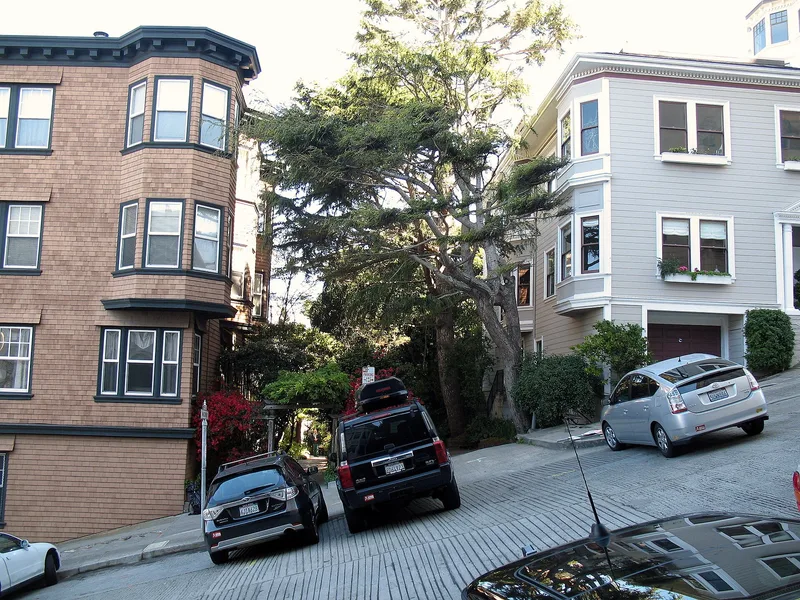
Tucked onto the steep north slope of Russian Hill in San Francisco, this small district centers on Macondray Lane, a narrow public right-of-way used only as a footpath and lined with trees, gardens, brick, cobblestone and boardwalk. Eighteen two- and three-story frame houses and flats, plus the lane itself, sit on the surrounding block along Green, Jones and Taylor Streets. The earliest building dates to 1878, and four buildings survived the 1906 fire; nearly all the rest were built within the next three years, mostly by contractors rather than known architects. Styles are vernacular Colonial Revival, Craftsman and Mission Revival, with Italianate and Queen Anne examples. The district was recognized for its architecture and its village-like atmosphere, which contrasts with the surrounding streets of small apartment buildings. Residents included painter Giuseppe Cadenasso, writer Charles Caldwell Dobie, and humanitarian Anita Whitney, along with a prosperous Italian-American community.
Significance in brief: The nomination argues the district is a picturesque, woodsy, village-like enclave of vernacular and near-vernacular architecture set in lush landscaping on a view-rich hillside. It also has a history of artistic and Bohemian residents and a prosperous Italian-American community. Several buildings survived the 1906 earthquake and fire, an unusually high number for the surrounding devastation.
Machine-generated summary. This summary was generated by a language model from the official nomination document and has not been reviewed line by line by an editor. It may contain errors. Check the source document before relying on any detail. Source: nomination document (PDF) · National Archives catalog entry. NRHP reference 87002286, listed January 7, 1988. Summary generated October 2026 (model claude-sonnet-5-5, prompt v1.0-2026-10-29, confidence medium).
Key facts
| Address | Roughly 900--982 Green, 1918--1960 Jones, 15--84 Macondray & 1801--1809 Taylor, San Francisco |
|---|---|
| County | San Francisco |
| Listed | January 7, 1988 |
| Reference number | 87002286 |
| Resource type | District |
| Period of significance | 1878-1930 |
| Architect / builder | Multiple; including William Mooser & Son, John K. Branner, Louis Mastropasqua, Arthur J. Laib, Ratto Brothers, and Otto A. Craemer (most buildings designed by contractors) |
| Architectural style | Vernacular renditions of Colonial Revival, Craftsman, or Mission Revival; also Italianate and Queen Anne examples |
| Criteria |
|
| Areas of significance | Landscape Architecture, Art, European, Architecture, Social History |
| Level of significance | Local |
| Status (as stated in the nomination) | Condition is generally good; two non-contributing, vacant and deteriorated buildings (900-910 and 920-930 Green) were demolished in June 1987. Mostly occupied private residences. |
| Acreage | 1.6 |
| Coordinates | 37.79918, -122.41305 (NPS GIS) |
What listing means for this property
This is a historic district. Buildings within its boundary are either contributing (they add to the district's significance) or non-contributing. Owners of contributing income-producing buildings can claim the 20% federal rehabilitation tax credit; homeowners should look at state credits. National Register districts impose no design review by themselves; a local historic district ordinance, if one exists, does (the difference explained).
General information, not legal or tax advice. Rules change; confirm with your State Historic Preservation Office or a qualified adviser.
Sources and further reading
- National Park Service, National Register of Historic Places database (snapshot May 2026), reference 87002286.
- Nomination form (PDF, National Archives) — catalog entry
- Wikipedia article (used for cross-checking only; text not reproduced here)
- Wikidata Q7382061
- This listing as JSON
Last updated October 2026. Found an error? See the editorial policy for how to report it.