Aquatic Park Historic District
Also known as: Aquatic Park

Why it's listed
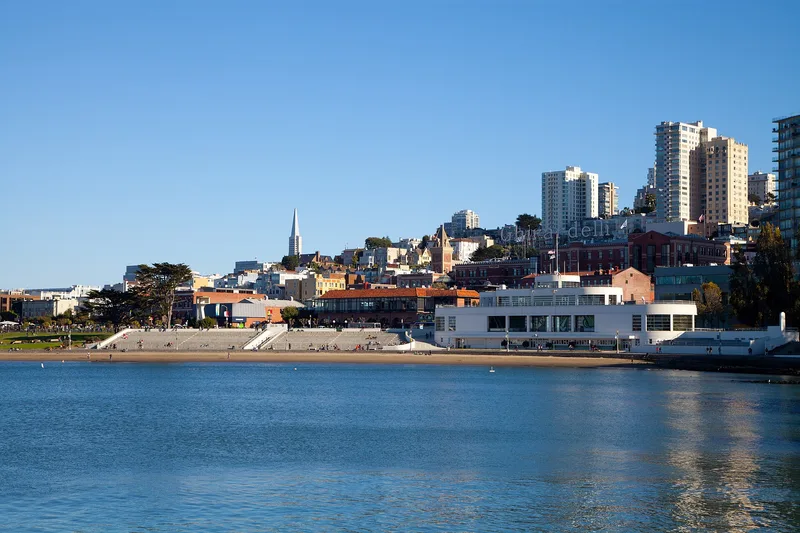
Aquatic Park is a waterfront recreation complex in San Francisco, built on the site of Black Point Cove, which was partly filled by industry and earthquake debris in the 19th and early 20th centuries. Work funded by the Works Progress Administration produced a new beach, a four-story oval bathhouse designed by William Mooser Sr. and Jr., stadia, a curved municipal pier, a concessions stand, restrooms, a granite-block seawall and two speaker towers. Completed in 1939, the group follows the Streamlined Moderne style, with porthole windows, ship-like railings and rounded walls recalling an ocean liner. Inside the bathhouse are murals, mosaics and sculpture by Hilaire Hiler, Sargent Johnson, Beniamino Bufano and others. The park was listed for its architectural and landscape design, its integrity, and its 1930s federal art. It also served as headquarters for anti-aircraft defense of the Pacific coast states during World War II. The bathhouse now houses a maritime museum.
Significance in brief: The nomination argues the park is nationally significant in architecture and landscape architecture for its thorough Streamlined Moderne design, with a curved pier, rounded buildings and nautical motifs. It also holds federally funded 1930s art by Hilaire Hiler, Sargent Johnson and Beniamino Bufano. It has regional military significance as headquarters of Pacific coast anti-aircraft defense in World War II.
Machine-generated summary. This summary was generated by a language model from the official nomination document and has not been reviewed line by line by an editor. It may contain errors. Check the source document before relying on any detail. Source: nomination document (PDF) · National Archives catalog entry. NRHP reference 84001183, listed January 26, 1984. Summary generated October 2026 (model claude-sonnet-5-5, prompt v1.0-2026-10-29, confidence high).
Key facts
| Address | Bounded by Van Ness Ave., Hyde and Polk Sts., San Francisco |
|---|---|
| County | San Francisco |
| Listed | January 26, 1984 |
| Reference number | 84001183 |
| Resource type | District |
| Period of significance | 1920-1945 |
| Architect / builder | William Mooser, Sr. and Jr. |
| Architectural style | Streamlined Moderne |
| Areas of significance | Community Planning and Development, Art, Military, Architecture |
| Level of significance | National |
| National Historic Landmark | Yes, designated May 28, 1987 |
| Status (as stated in the nomination) | Largely unaltered since 1939; the bathhouse is now the Maritime Museum building and is in good structural condition, with some moisture damage to concrete walls. |
| Acreage | 1 |
| Within district | Port of San Francisco Embarcadero Historic District |
| Coordinates | 37.80843, -122.41392 (NPS GIS) |
What listing means for this property
This is a historic district. Buildings within its boundary are either contributing (they add to the district's significance) or non-contributing. Owners of contributing income-producing buildings can claim the 20% federal rehabilitation tax credit; homeowners should look at state credits. National Register districts impose no design review by themselves; a local historic district ordinance, if one exists, does (the difference explained).
General information, not legal or tax advice. Rules change; confirm with your State Historic Preservation Office or a qualified adviser.
Sources and further reading
- National Park Service, National Register of Historic Places database (snapshot May 2026), reference 84001183.
- Nomination form (PDF, National Archives) — catalog entry
- Wikipedia article (used for cross-checking only; text not reproduced here)
- Wikidata Q2475631
- This listing as JSON
Last updated October 2026. Found an error? See the editorial policy for how to report it.