Granger Hall
Also known as: Granger Music Hall

Why it's listed
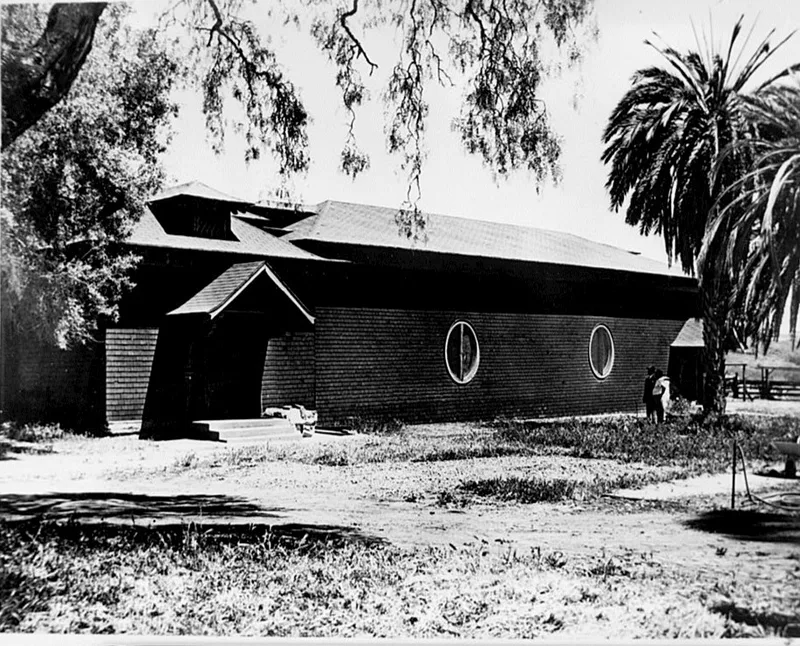
Granger Music Hall is a single-story, cedar-shingled wood frame concert hall built in 1898 in National City, California, by Ralph Granger, who made his fortune from a Colorado silver mine. Its 100 by 32 foot plan seats 150 and grew from a music room he built on his Paradise Valley estate in 1896. The design is attributed to architect Irving John Gill, and no two walls or surfaces are parallel, giving near-perfect acoustics. The ceiling carries a 75-foot mural of Euterpe, and the stage once fronted a 1060-pipe Murray Harris organ. Performers such as Ysaye, Hambourg and Friml appeared here, with Granger often guaranteeing artists' fees. The building was moved twelve blocks to El Toyon Park in 1969 after its land was sold. Fire, water and vandal damage followed, and local civic groups have since worked on restoration. It was recognized for its architecture, music and theater associations.
Significance in brief: The nomination cites the hall's association with Ralph Granger, a Colorado silver mine fortune holder who became a civic leader and patron of music. The design is attributed to architect Irving John Gill, and the hall was considered acoustically perfect. It hosted world-famous performers and is believed to be one of two privately owned music halls in the United States.
Machine-generated summary. This summary was generated by a language model from the official nomination document and has not been reviewed line by line by an editor. It may contain errors. Check the source document before relying on any detail. Source: nomination document (PDF) · National Archives catalog entry. NRHP reference 75000465, listed March 18, 1975. Summary generated October 2026 (model claude-sonnet-5-5, prompt v1.0-2026-10-29, confidence medium).
Key facts
| Address | 1700 E. 4th St., National City |
|---|---|
| County | San Diego County |
| Listed | March 18, 1975 |
| Reference number | 75000465 |
| Resource type | Building |
| Period of significance | 19th Century |
| Architect / builder | Irving John Gill (architect); Ralph Granger (builder/owner) |
| Areas of significance | Entertainment/Recreation, Architecture |
| Level of significance | Local |
| Status (as stated in the nomination) | Relocated in 1969 to a park site and set on a new foundation; fire, water and vandal damage noted, with restoration and repair under way through donations from local clubs and businesses. Condition listed as deteriorated. |
| Acreage | 0.7 |
| Coordinates | 32.68433, -117.09089 (NPS GIS) |
What listing means for this property
National Register listing is honorary for a privately owned home: it does not by itself restrict what an owner may do with their own money, and it does not require public access. Restrictions come from local landmark or historic-district ordinances, which are separate (how they differ).
Owner-occupied houses are not eligible for the 20% federal rehabilitation tax credit, which applies to income-producing buildings, but many states offer credits for homeowners. Listing also opens the door to preservation easements and to buying a plaque. Start with what listing means for homeowners, renovating a listed house and selling one.
General information, not legal or tax advice. Rules change; confirm with your State Historic Preservation Office or a qualified adviser.
Sources and further reading
- National Park Service, National Register of Historic Places database (snapshot May 2026), reference 75000465.
- Nomination form (PDF, National Archives) — catalog entry
- Wikipedia article (used for cross-checking only; text not reproduced here)
- Wikidata Q5884909
- This listing as JSON
Last updated October 2026. Found an error? See the editorial policy for how to report it.