Webber, John Lee, House
Also known as: The Webber Place
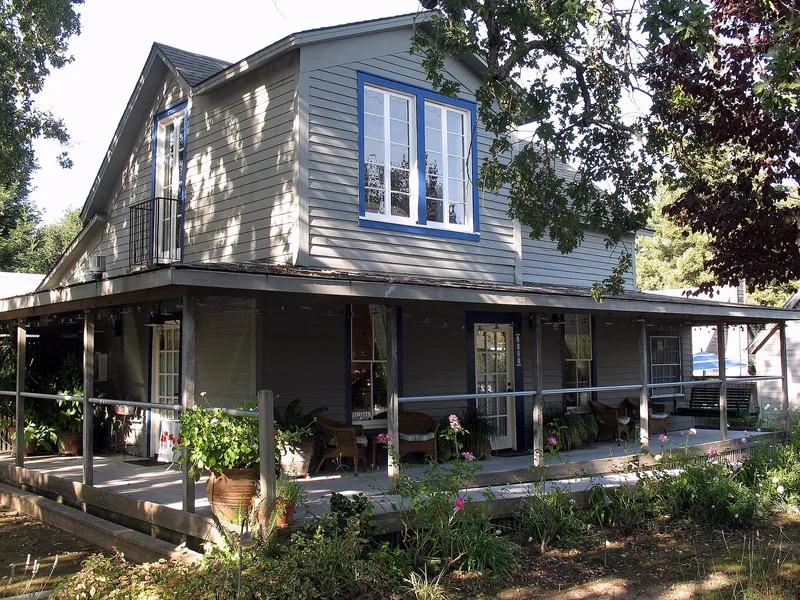

Why it's listed
Located on a corner lot in Yountville, this two-storey frame farmhouse began as a one-and-a-half-storey Greek Revival dwelling built before 1859 on the Finnell Ranch, less than a mile east. It was moved to its present site in the 1860s. The Webber family enlarged it in 1907-08, adding a gabled second-storey room over the front porch and extending the kitchen wing north. A two-storey shiplap barn, built in 1905, opens onto Webber Street. The property is tied to the Grigsby family, who settled the Yountville area in 1845, and to John Lee Webber, who served as Napa County Supervisor from 1904 until his death in 1912. He championed replacing wooden bridges with stone, helping give Napa County the name County of Stone Bridges. His sons also held county posts. The house remained in the family until 1929 and now serves as a country inn.
Significance in brief: The house links two families important to Napa County development: the Grigsby pioneer family of 1845 and the Webber family, active in county government for two generations. John Lee Webber served as County Supervisor from 1904 to 1912 and promoted stone bridges. The property also reflects the 19th-century practice of moving buildings and shows a residence evolving from the mid-19th to the early 20th century.
Machine-generated summary. This summary was generated by a language model from the official nomination document and has not been reviewed line by line by an editor. It may contain errors. Check the source document before relying on any detail. Source: nomination document (PDF) · National Archives catalog entry. NRHP reference 82002219, listed January 19, 1982. Summary generated October 2026 (model claude-sonnet-5-5, prompt v1.0-2026-10-29, confidence high).
Key facts
| Address | 6610 Webber St., Yountville |
|---|---|
| County | Napa County |
| Listed | January 19, 1982 |
| Reference number | 82002219 |
| Resource type | Building |
| Architectural style | Simplified Greek Revival |
| Criteria |
|
| Areas of significance | Exploration/Settlement, Politics/Government, Architecture |
| Level of significance | Local |
| Status (as stated in the nomination) | Renovated in 1979 and in use as a country inn; the barn is used for storage, with conversion to lodging planned. |
| Acreage | 0.4 |
| Coordinates | 38.40430, -122.36375 (NPS GIS) |
What listing means for this property
National Register listing is honorary for a privately owned home: it does not by itself restrict what an owner may do with their own money, and it does not require public access. Restrictions come from local landmark or historic-district ordinances, which are separate (how they differ).
Owner-occupied houses are not eligible for the 20% federal rehabilitation tax credit, which applies to income-producing buildings, but many states offer credits for homeowners. Listing also opens the door to preservation easements and to buying a plaque. Start with what listing means for homeowners, renovating a listed house and selling one.
General information, not legal or tax advice. Rules change; confirm with your State Historic Preservation Office or a qualified adviser.
Sources and further reading
- National Park Service, National Register of Historic Places database (snapshot May 2026), reference 82002219.
- Nomination form (PDF, National Archives) — catalog entry
- Wikipedia article (used for cross-checking only; text not reproduced here)
- Wikidata Q85771607
- This listing as JSON
Last updated October 2026. Found an error? See the editorial policy for how to report it.