San Antonio de Padua Mission

Why it's listed
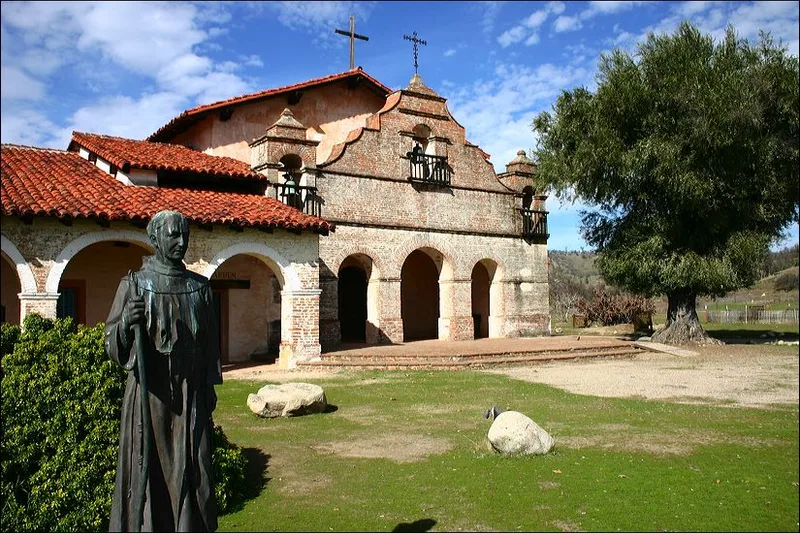
Mission San Antonio de Padua sits in a rural, oak-dotted valley near Jolon in Monterey County, California. Fray Junipero Serra founded it on July 14, 1771, as the third in the chain of Franciscan missions in Alta California. The community moved to the present site in 1773 to be closer to fresh water. Residents added a large wing for Indian converts in 1790, built granaries, and constructed a water-powered flour mill in 1806. The present adobe church was begun in 1810 and finished in 1813, with a ten-foot rock foundation. Secularization in 1834 began a long decline. Restoration efforts in 1903 were undone by the 1906 earthquake, and the Franciscans began the current restoration in 1948. Excavation guided the work, and thousands of adobes were remade from the fallen walls. Today the church, quadrangle wings and a museum survive in a pastoral setting. The nomination ties the mission's importance to Spanish colonization, early California agriculture and mission architecture.
Significance in brief: The nomination argues regional significance as the third mission in the chain of Franciscan missions in Alta California, founded by Fray Junipero Serra in 1771. It also stresses the mission's role in Spanish colonization, its early agriculture and engineering, including a water-powered flour mill, and its rural setting, unlike most other missions.
Machine-generated summary. This summary was generated by a language model from the official nomination document and has not been reviewed line by line by an editor. It may contain errors. Check the source document before relying on any detail. Source: nomination document (PDF) · National Archives catalog entry. NRHP reference 76000504, listed April 26, 1976. Summary generated October 2026 (model claude-sonnet-5-5, prompt v1.0-2026-10-29, confidence medium).
Key facts
| Address | NW of Jolon off Del Venturi Rd., Jolon |
|---|---|
| County | Monterey County |
| Listed | April 26, 1976 |
| Reference number | 76000504 |
| Resource type | Building |
| Period of significance | 1700-1799, 1800-1899 |
| Architect / builder | Fray Buenaventura Sitjar (master builder); church built under Padres Cabot and Juan Bautista Sancho; restoration directed by Harry Downie |
| Architectural style | Mission |
| Areas of significance | Native American, Hispanic, Architecture, Religion |
| Level of significance | National |
| Status (as stated in the nomination) | Restored beginning in 1948 and in excellent condition. The front wing is a museum, and other buildings serve as rooms for retreats, seminars and workshops. |
| Acreage | 85 |
| Coordinates | 36.01380, -121.25014 (NPS GIS) |
What listing means for this property
National Register listing is honorary: it recognises significance and does not restrict what a private owner may do without federal money or permits. It unlocks the 20% federal rehabilitation tax credit for income-producing buildings, state credits in many states, and Section 106 review when federal agencies are involved. See what listing means in practice.
General information, not legal or tax advice. Rules change; confirm with your State Historic Preservation Office or a qualified adviser.
Sources and further reading
- National Park Service, National Register of Historic Places database (snapshot May 2026), reference 76000504.
- Nomination form (PDF, National Archives) — catalog entry
- Wikipedia article (used for cross-checking only; text not reproduced here)
- Wikidata Q6878709
- This listing as JSON
Last updated October 2026. Found an error? See the editorial policy for how to report it.