Russian Village District
Also known as: Rock Houses

Why it's listed
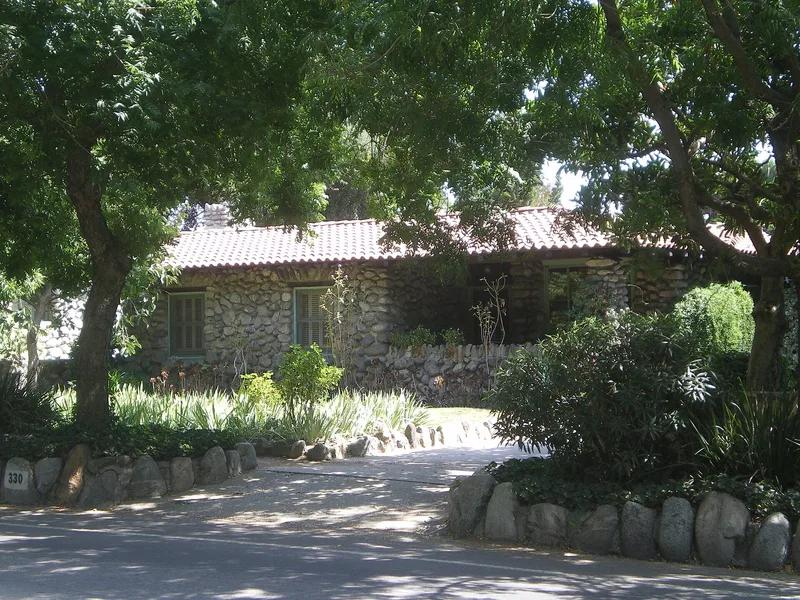
Fifteen houses on a single block of South Mills Avenue in Claremont and Montclair, California, make up the Russian Village, an unusual neighborhood of rock-built homes. Work began in 1923 when Konstany Stys, a Polish-born immigrant with only a grade school education, started building with fieldstone cleared from nearby groves. During the Great Depression the project grew into an informal community effort, using salvaged materials such as broken highway concrete slabs, reclaimed clay roof tile and old lumber. The houses have multi-gabled roofs, tall rock chimneys, iron balconies and low stone garden walls. The street has fieldstone curbing, no paved sidewalks and tall elms. Locals named it the Russian Village because Stys was mistakenly thought to be Russian. The nomination describes the neighborhood as folk architecture of high rank, unified by its materials and plantings and standing nearly alone among later tract housing. Most homes remain in excellent condition and are still private residences.
Significance in brief: The nomination presents the Village as an architectural achievement by a self-taught folk architect, Konstany Stys, who built or inspired the homes with salvaged and cheap local materials. Its harmony of materials, plantings and street setting gives it unity, and it stands almost alone amid later tract housing.
Machine-generated summary. This summary was generated by a language model from the official nomination document and has not been reviewed line by line by an editor. It may contain errors. Check the source document before relying on any detail. Source: nomination document (PDF) · National Archives catalog entry. NRHP reference 78000680, listed December 28, 1978. Summary generated October 2026 (model claude-sonnet-5-5, prompt v1.0-2026-10-29, confidence medium).
Key facts
| Address | 290--370 S. Mills Ave. and 480 Cucamonga Ave., Claremont |
|---|---|
| County | Los Angeles County |
| Listed | December 28, 1978 |
| Reference number | 78000680 |
| Resource type | District |
| Period of significance | 1923-1938 |
| Architect / builder | Konstany Stys and others |
| Architectural style | Folk architecture (rock architecture) |
| Areas of significance | Architecture, Social History |
| Level of significance | Local |
| Status (as stated in the nomination) | Occupied private residences; most of the fifteen houses are in excellent condition, with some alterations made to meet county codes. |
| Acreage | 3.2 |
| Coordinates | 34.09140, -117.70765 (NPS GIS) |
What listing means for this property
This is a historic district. Buildings within its boundary are either contributing (they add to the district's significance) or non-contributing. Owners of contributing income-producing buildings can claim the 20% federal rehabilitation tax credit; homeowners should look at state credits. National Register districts impose no design review by themselves; a local historic district ordinance, if one exists, does (the difference explained).
General information, not legal or tax advice. Rules change; confirm with your State Historic Preservation Office or a qualified adviser.
Sources and further reading
- National Park Service, National Register of Historic Places database (snapshot May 2026), reference 78000680.
- Nomination form (PDF, National Archives) — catalog entry
- Wikipedia article (used for cross-checking only; text not reproduced here)
- Wikidata Q7382156
- This listing as JSON
Last updated October 2026. Found an error? See the editorial policy for how to report it.