Pasadena Playhouse Historic District
Also known as: See Also:Singer Building; First Trust Building; Pasadena Playh

Why it's listed
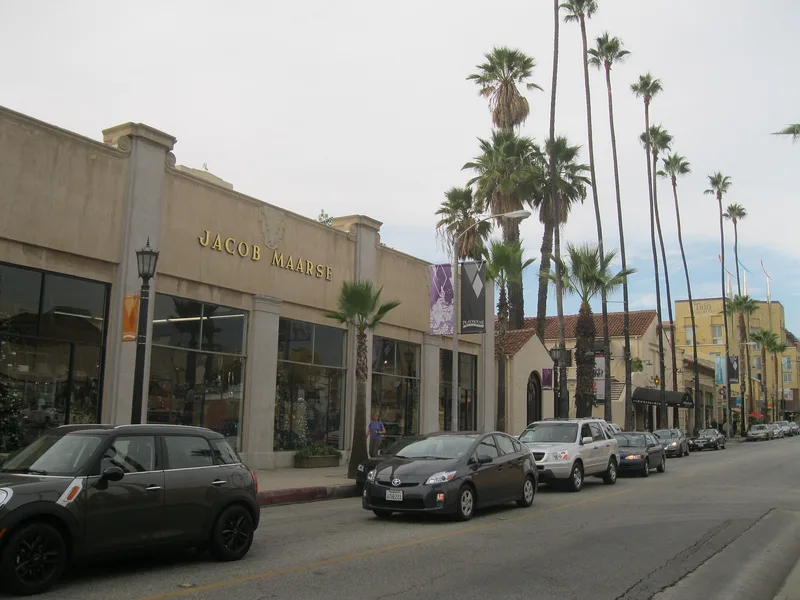
Pasadena Playhouse Historic District is a collection of roughly 50 buildings in Pasadena, California, centered on Colorado Boulevard, Green Street, South El Molino Avenue and Madison Avenue. It reflects the 1920s and 1930s shift of the city's business, cultural and religious life eastward from the older downtown, spurred partly by construction of the Civic Center. Small one- and two-story shops dominate, mixed with taller commercial buildings such as the Star-News and First Trust buildings, large churches, apartments and a few early houses. Styles range from Spanish Colonial Revival, seen in the Singer Building and Lockwood Building, to Art Deco, Georgian Revival, Gothic Revival and Classical Revival. The Pasadena Playhouse anchors the district culturally. The district was recognized for its role in Pasadena's urban expansion, its commerce and performing arts history, and its architectural variety. Its period of significance runs from 1906 to 1944, and most contributing buildings keep their historic character.
Significance in brief: The district is argued to be the most intact and contiguous collection of buildings from Pasadena's 'second wave' of growth, when commerce and culture moved eastward from the old downtown. It meets Criterion A for community planning, commerce and the performing arts, and Criterion C for its many examples of period architectural styles.
Machine-generated summary. This summary was generated by a language model from the official nomination document and has not been reviewed line by line by an editor. It may contain errors. Check the source document before relying on any detail. Source: nomination document (PDF) · National Archives catalog entry. NRHP reference 94000462, listed May 19, 1994. Summary generated October 2026 (model claude-sonnet-5-5, prompt v1.0-2026-10-29, confidence medium).
Key facts
| Address | 464--611 E. Colorado Blvd., 550--655 E. Green St., 21--127 S. El Molino Ave., and 150 N.--101 S. Madison Ave., Pasadena |
|---|---|
| County | Los Angeles County |
| Listed | May 19, 1994 |
| Reference number | 94000462 |
| Resource type | District |
| Period of significance | 1906-1944 |
| Architect / builder | Multiple, including Marston and Maybury; Bennett and Haskell; Joseph J. Blick; Everett Phipps Babcock; Thomas P. Barber |
| Architectural style | Spanish Colonial Revival, Art Deco, Beaux Arts |
| Criteria |
|
| Areas of significance | Architecture, Community Planning and Development, Performing Arts, Commerce |
| Level of significance | Local |
| Status (as stated in the nomination) | Most contributing buildings generally retain their appearance from the period of significance, though some have been altered; the district is still used for theater, retail, religious, financial, professional and residential purposes. |
| Acreage | 24.5 |
| Coordinates | 34.14749, -118.13919 (NPS GIS) |
What listing means for this property
This is a historic district. Buildings within its boundary are either contributing (they add to the district's significance) or non-contributing. Owners of contributing income-producing buildings can claim the 20% federal rehabilitation tax credit; homeowners should look at state credits. National Register districts impose no design review by themselves; a local historic district ordinance, if one exists, does (the difference explained).
General information, not legal or tax advice. Rules change; confirm with your State Historic Preservation Office or a qualified adviser.
Sources and further reading
- National Park Service, National Register of Historic Places database (snapshot May 2026), reference 94000462.
- Nomination form (PDF, National Archives) — catalog entry
- Wikidata Q141634214
- This listing as JSON
Last updated October 2026. Found an error? See the editorial policy for how to report it.