Civic Center Financial District

Why it's listed
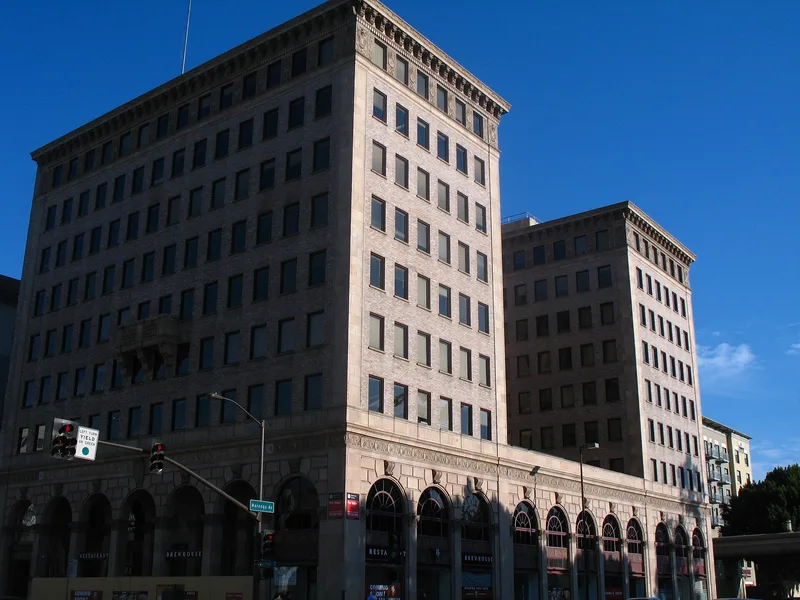
Five bank and office buildings cluster around East Colorado Boulevard and Marengo Avenue in Pasadena, forming a small financial district built between 1905 and 1928. An eight-story Second Renaissance Revival bank and a seven-story Neo-Classical bank anchor the group. Three two-story buildings extend north along Marengo Avenue. Architects include Curlett and Beelman, John Parkinson and Edwin Bergstrom, Benjamin G. Horton, and Leon C. Brockway. The district grew as Pasadena's commercial center spread eastward from Old Pasadena and as the nearby Civic Center, built from 1915 into the early 1930s, drew banks and offices to the area. Its classical styling gave the buildings prestige and a visual link to the civic institutions. The two large banks, set on a rise, have long formed a gateway to the Civic Center. Interiors such as the Citizens Bank banking room remain largely intact, and the buildings are valued for their architecture and their place in the city's downtown development.
Significance in brief: The district is significant both as a group reflecting Pasadena's early twentieth-century commercial growth, especially in the 1920s, and for the high-quality architecture of its individual buildings. It forms a link between the nearby Civic Center development, the evolution of downtown, and local architectural trends. The buildings use classical design and were produced by leading Los Angeles and Pasadena architects.
Machine-generated summary. This summary was generated by a language model from the official nomination document and has not been reviewed line by line by an editor. It may contain errors. Check the source document before relying on any detail. Source: nomination document (PDF) · National Archives catalog entry. NRHP reference 82000967, listed October 29, 1982. Summary generated October 2026 (model claude-sonnet-5-5, prompt v1.0-2026-10-29, confidence high).
Key facts
| Address | E. Colorado Blvd. and Marengo Ave., Pasadena |
|---|---|
| County | Los Angeles County |
| Listed | October 29, 1982 |
| Reference number | 82000967 |
| Resource type | District |
| Period of significance | 1905-1928 |
| Architect / builder | Multiple: Curlett and Beelman; John Parkinson and Edwin Bergstrom; Benjamin G. Horton; W. B. Edwards; C. F. Driscoll; Leon C. Brockway |
| Architectural style | Neo-Classical, Second Renaissance Revival, and Beaux-Arts |
| Areas of significance | Commerce, Architecture |
| Level of significance | Local |
| Status (as stated in the nomination) | Listed as occupied and in good condition, with some alterations to storefronts and the Security Pacific banking room; the form says the district retains its architectural integrity. |
| Acreage | 1.2 |
| Within district | Pasadena Civic Center District |
| Coordinates | 34.14600, -118.14567 (NPS GIS) |
What listing means for this property
This is a historic district. Buildings within its boundary are either contributing (they add to the district's significance) or non-contributing. Owners of contributing income-producing buildings can claim the 20% federal rehabilitation tax credit; homeowners should look at state credits. National Register districts impose no design review by themselves; a local historic district ordinance, if one exists, does (the difference explained).
General information, not legal or tax advice. Rules change; confirm with your State Historic Preservation Office or a qualified adviser.
Sources and further reading
- National Park Service, National Register of Historic Places database (snapshot May 2026), reference 82000967.
- Nomination form (PDF, National Archives) — catalog entry
- Wikipedia article (used for cross-checking only; text not reproduced here)
- Wikidata Q14681760
- This listing as JSON
Last updated October 2026. Found an error? See the editorial policy for how to report it.