Knapp Cabin
Also known as: Artist's Cabin

Why it's listed
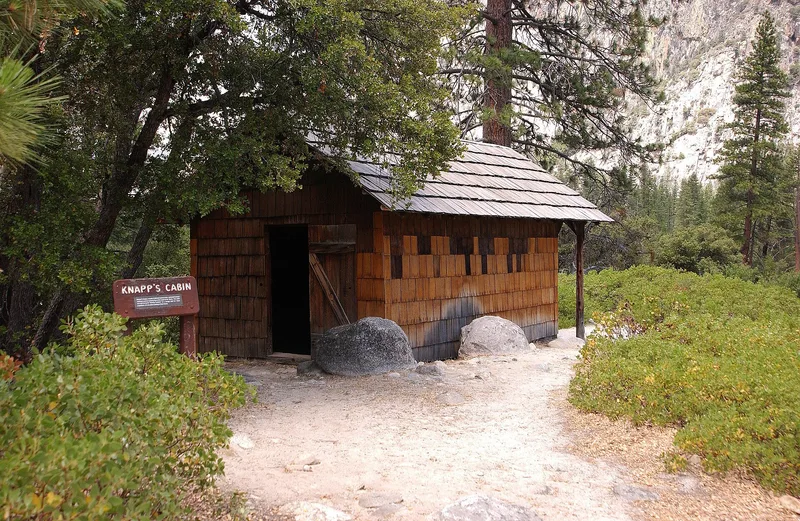
Built in 1925 for George Owen Knapp, a Union Carbide executive, this one-room cabin stands in the valley of the South Fork of the Kings River, west of Cedar Grove in Kings Canyon National Park. Its pole frame, some of the poles squared, came from the surrounding pine and cedar forest, and the walls and roof are covered in shakes probably cut from nearby cedar. The cabin measures about 10 by 20 feet, with a door at each end, no windows, a dirt floor and a small porch formed by an extended gable. Knapp did not use it as a residence. He and his friends camped along the riverbank and kept equipment and supplies in the cabin until he stopped visiting by 1928. Parties visiting the canyon used it occasionally in the following decade, and use ended after the park was established in 1940. It is listed as a reminder of pre-park recreation in the Kings River canyons, and its setting remains much as Knapp knew it apart from the road.
Significance in brief: The nomination argues it is one of the few surviving reminders of recreational use of the Kings River canyons before Kings Canyon National Park was created in 1940. It is judged of local significance in conservation and recreation. Federal reviewers accepted it as a rare building type tied to early development of the park and to Knapp.
Machine-generated summary. This summary was generated by a language model from the official nomination document and has not been reviewed line by line by an editor. It may contain errors. Check the source document before relying on any detail. Source: nomination document (PDF) · National Archives catalog entry. NRHP reference 78000291, listed December 20, 1978. Summary generated October 2026 (model claude-sonnet-5-5, prompt v1.0-2026-10-29, confidence medium).
Key facts
| Address | W of Cedar Grove in Kings Canyon National Park, Cedar Grove |
|---|---|
| County | Fresno County |
| Listed | December 20, 1978 |
| Reference number | 78000291 |
| Resource type | Building |
| Period of significance | 1925 |
| Architect / builder | George Owen Knapp |
| Areas of significance | Conservation |
| Level of significance | Local |
| Status (as stated in the nomination) | Unaltered except for a new shake roof added by the National Park Service about 1966; managed by the National Park Service as a historic structure since the 1950s. |
| Acreage | 0.2 |
| Within district | Shorty Lovelace Historic District |
| Coordinates | 36.78379, -118.63688 (NPS GIS) |
What listing means for this property
National Register listing is honorary for a privately owned home: it does not by itself restrict what an owner may do with their own money, and it does not require public access. Restrictions come from local landmark or historic-district ordinances, which are separate (how they differ).
Owner-occupied houses are not eligible for the 20% federal rehabilitation tax credit, which applies to income-producing buildings, but many states offer credits for homeowners. Listing also opens the door to preservation easements and to buying a plaque. Start with what listing means for homeowners, renovating a listed house and selling one.
General information, not legal or tax advice. Rules change; confirm with your State Historic Preservation Office or a qualified adviser.
Sources and further reading
- National Park Service, National Register of Historic Places database (snapshot May 2026), reference 78000291.
- Nomination form (PDF, National Archives) — catalog entry
- Wikipedia article (used for cross-checking only; text not reproduced here)
- Wikidata Q14682985
- This listing as JSON
Last updated October 2026. Found an error? See the editorial policy for how to report it.