Wythe County Poorhouse Farm

Why it's listed
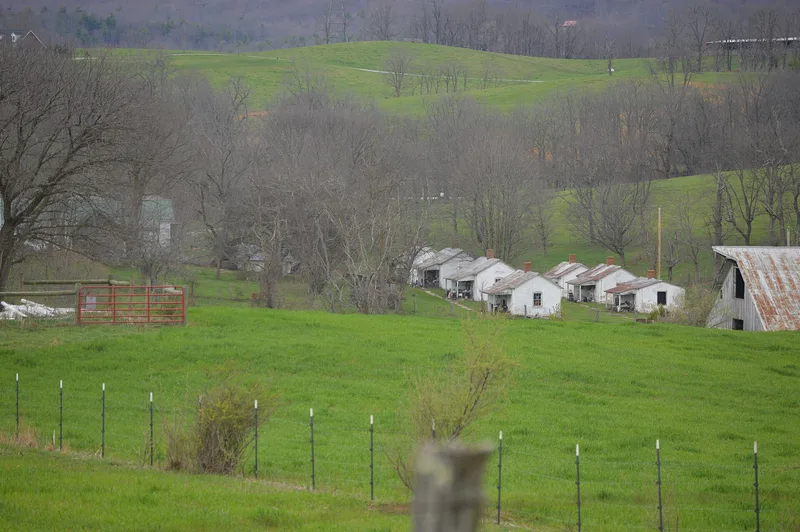
Wythe County bought 340 acres northeast of Wytheville in 1858 to replace its first poorhouse, which had operated from 1825 until 1858. The nominated 9.09 acres hold the core of that second poor farm: a ca. 1890 two-story frame overseer's house, eight brick pauper houses, a log smokehouse, a wash house, a chicken house, a shed and a springhouse. Each pauper house has two 16-by-16-foot rooms heated by a central chimney. Census records show the farm typically housed 20 to 30 residents, with 56 in 1870, and the county later contracted doctors to care for them. The farm operated until the county sold it in 1957. It is the only surviving poorhouse farm in Wythe County and may be the best of its kind in southwest Virginia, and its rural setting has changed little. Restoration has kept most original materials, and the site is open for visits.
Significance in brief: It is the only surviving poorhouse farm in Wythe County and possibly the best surviving one in southwest Virginia. It is significant for social history and health/medicine because the county provided shelter, food and medical care for the poor, and for the architecture of its pauper houses. The setting remains largely undisturbed.
Machine-generated summary. This summary was generated by a language model from the official nomination document and has not been reviewed line by line by an editor. It may contain errors. Check the source document before relying on any detail. Source: nomination document (PDF) · National Archives catalog entry. NRHP reference 00000557, listed May 26, 2000. Summary generated October 2026 (model claude-sonnet-5-5, prompt v1.0-2026-10-29, confidence high).
Key facts
| Address | VA 2, Peppers Ferry Rd., Wytheville |
|---|---|
| County | Wythe County |
| Listed | May 26, 2000 |
| Reference number | 00000557 |
| Resource type | Building |
| Period of significance | 1858-1949 |
| Architectural style | Late Victorian Queen Anne |
| Criteria |
|
| Areas of significance | Social History, Health/Medicine, Architecture |
| Level of significance | Local |
| Status (as stated in the nomination) | Restored by its owners and open to the public for visitation at no charge; the overseer's house is in excellent condition. One pauper house has partly collapsed and the springhouse was ruined by an ice storm. |
| Acreage | 9.1 |
| Coordinates | 36.98182, -81.02812 (NPS GIS) |
What listing means for this property
National Register listing is honorary for a privately owned home: it does not by itself restrict what an owner may do with their own money, and it does not require public access. Restrictions come from local landmark or historic-district ordinances, which are separate (how they differ).
Owner-occupied houses are not eligible for the 20% federal rehabilitation tax credit, which applies to income-producing buildings, but many states offer credits for homeowners. Listing also opens the door to preservation easements and to buying a plaque. Start with what listing means for homeowners, renovating a listed house and selling one.
General information, not legal or tax advice. Rules change; confirm with your State Historic Preservation Office or a qualified adviser.
Sources and further reading
- National Park Service, National Register of Historic Places database (snapshot May 2026), reference 00000557.
- Nomination form (PDF, National Archives) — catalog entry
- Wikipedia article (used for cross-checking only; text not reproduced here)
- Wikidata Q16903838
- This listing as JSON
Last updated October 2026. Found an error? See the editorial policy for how to report it.