Kimberling Lutheran Cemetery

Why it's listed
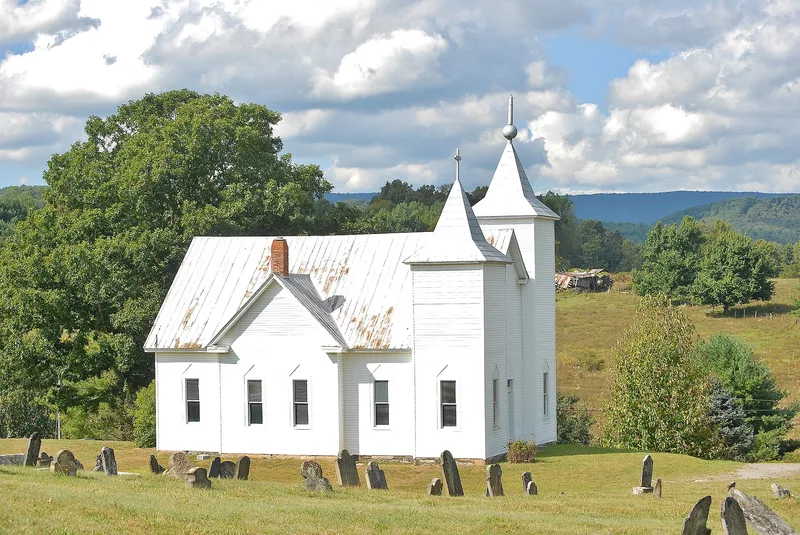
Kimberling Lutheran Cemetery occupies about three acres on a steep, cleared hillside overlooking the rolling country of western Wythe County. It contains roughly fifty sandstone gravestones dating from 1800 to 1850, making it one of a few places in Southwest Virginia with a notable group of early German markers. Many inscriptions have weathered away. The stones are typically decorated on the reverse with a single high-relief motif, such as hearts, upside-down anchors, fylfot crosses, six-pointed stars, ladder-like devices or plant forms. Inscriptions are almost entirely in English, showing how local Germans were adopting Anglo-American customs while keeping traditional religious symbols. The last stone using those motifs dates from 1850. The congregation's first church was dedicated in 1797. The present large frame church, the third on the site, was built in 1913 with two towers, Gothic-style openings and pressed-tin shingles. The cemetery remains in use today.
Significance in brief: The cemetery holds an outstanding collection of traditional German gravestones from 1800-1850, one of a small number of such collections in Southwest Virginia. The carved stones combine Germanic religious motifs with 19th-century English-influenced forms and inscriptions. They show how German settlers in Wythe County were assimilating into English-speaking culture.
Machine-generated summary. This summary was generated by a language model from the official nomination document and has not been reviewed line by line by an editor. It may contain errors. Check the source document before relying on any detail. Source: nomination document (PDF) · National Archives catalog entry. NRHP reference 80004231, listed March 26, 1980. Summary generated October 2026 (model claude-sonnet-5-5, prompt v1.0-2026-10-29, confidence high).
Key facts
| Address | NW of Rural Retreat, Rural Retreat |
|---|---|
| County | Wythe County |
| Listed | March 26, 1980 |
| Reference number | 80004231 |
| Resource type | District |
| Period of significance | 1800-1899, 1900- (cemetery from 1800; church 1913) |
| Architectural style | Frame church with "Gothic" window and door openings; Germanic folk-art gravestones |
| Areas of significance | Art, European, Exploration/Settlement, Religion |
| Level of significance | State |
| Status (as stated in the nomination) | Cemetery continues in active use; condition listed as excellent, original site, and the church is occupied. |
| Acreage | 3 |
| Coordinates | 36.91752, -81.30463 (NPS GIS) |
What listing means for this property
This is a historic district. Buildings within its boundary are either contributing (they add to the district's significance) or non-contributing. Owners of contributing income-producing buildings can claim the 20% federal rehabilitation tax credit; homeowners should look at state credits. National Register districts impose no design review by themselves; a local historic district ordinance, if one exists, does (the difference explained).
General information, not legal or tax advice. Rules change; confirm with your State Historic Preservation Office or a qualified adviser.
Sources and further reading
- National Park Service, National Register of Historic Places database (snapshot May 2026), reference 80004231.
- Nomination form (PDF, National Archives) — catalog entry
- Wikipedia article (used for cross-checking only; text not reproduced here)
- Wikidata Q15238489
- This listing as JSON
Last updated October 2026. Found an error? See the editorial policy for how to report it.