Holland-de Witt Cottage (Additional Documentation and Name Change)
Also known as: de Witt Cottage; The Brick House; Witzand/Wittenzand; Atlantic Wildfowl Heritage Museum; Vdhr # 134-0066; 44vb0434

Why it's listed
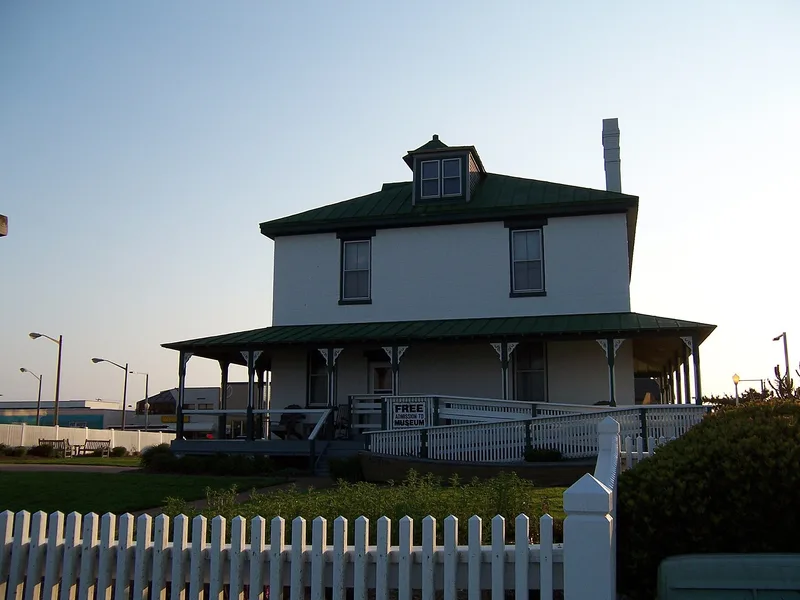
Built in 1895 on the Virginia Beach oceanfront, this two-story brick cottage was first occupied by B. P. Holland, an avid hunter who added a small open cupola as a lookout over the lakes behind the house. The L-shaped building has fourteen-inch-thick brick walls, a hip roof with dormers, a full basement and a one-story wood porch with modest Queen Anne brackets and columns. Inside, beaded pine paneling remains largely intact. The de Witt family bought the house in 1909 and lived there until January 1988, also taking in paying guests from about 1932 to 1970. Changes were limited to a 1917 second-floor addition over the kitchen wing, storm repairs and updated utilities. The nomination considers it the last surviving example of the early oceanfront dwellings built when Virginia Beach developed as a resort, now surrounded by high-rise hotels and condominiums. At listing it stood boarded up but structurally sound.
Significance in brief: The nomination argues it is the sole surviving example of the oceanfront dwellings built in Virginia Beach's first development period (1883-1906). It is tied to the growth of oceanfront resorts (Criterion A) and retains high architectural integrity as an informal beach house (Criterion C). Surrounding early development has been replaced by high-rise hotels and condominiums.
Machine-generated summary. This summary was generated by a language model from the official nomination document and has not been reviewed line by line by an editor. It may contain errors. Check the source document before relying on any detail. Source: nomination document (PDF) · National Archives catalog entry. NRHP reference 88000748, listed June 16, 1988. Summary generated October 2026 (model claude-sonnet-5-5, prompt v1.0-2026-10-29, confidence high).
Key facts
| Address | 1113 Atlantic Avenue, Virginia Beach (Independent City) |
|---|---|
| County | Virginia Beach |
| Listed | June 16, 1988 |
| Reference number | 88000748 |
| Resource type | Building |
| Period of significance | 1895 - 1937 |
| Architect / builder | Unknown |
| Architectural style | Late Victorian: Queen Anne (primarily vernacular with secondary Queen Anne detailing) |
| Criteria |
|
| Areas of significance | Entertainment/Recreation, Architecture, Commerce, Politics/Government |
| Level of significance | Local |
| Status (as stated in the nomination) | Vacated in January 1988 and boarded up against vandalism; in fair but structurally sound condition, still owned by the de Witt family. |
| Acreage | 0.36 |
| Coordinates | 36.84054, -75.97240 (NPS GIS) |
What listing means for this property
National Register listing is honorary for a privately owned home: it does not by itself restrict what an owner may do with their own money, and it does not require public access. Restrictions come from local landmark or historic-district ordinances, which are separate (how they differ).
Owner-occupied houses are not eligible for the 20% federal rehabilitation tax credit, which applies to income-producing buildings, but many states offer credits for homeowners. Listing also opens the door to preservation easements and to buying a plaque. Start with what listing means for homeowners, renovating a listed house and selling one.
Noted as vacant in the nomination. Nomination documents can be decades old; current status may differ. If you are considering buying an empty listed property, read the due-diligence checklist.
General information, not legal or tax advice. Rules change; confirm with your State Historic Preservation Office or a qualified adviser.
Sources and further reading
- National Park Service, National Register of Historic Places database (snapshot May 2026), reference 88000748.
- Nomination form (PDF, National Archives) — catalog entry
- Wikipedia article (used for cross-checking only; text not reproduced here)
- Wikidata Q16829095
- This listing as JSON
Last updated October 2026. Found an error? See the editorial policy for how to report it.