Somerton Historic District
Also known as: Vdhr#133-5256

Why it's listed
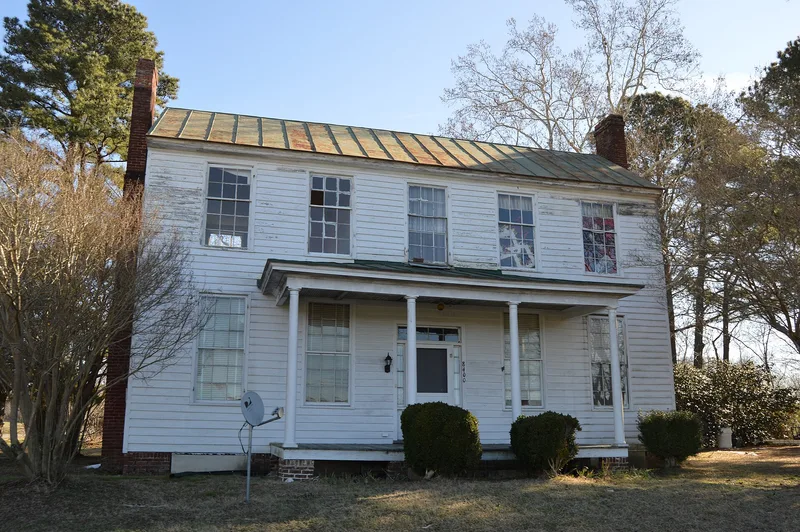
Somerton is a small rural village district on the southern edge of Suffolk, Virginia, covering about 236 acres of homes, outbuildings and farm fields. English settlement began in the 17th century, when Thomas Jernigan received a 250-acre grant in 1668. The buildings are one and two-story frame structures from the late 18th to early 20th centuries, in vernacular versions of styles from Federal to Folk Victorian. Key buildings include the Washington Smith Ordinary, an inn that also served as a family home, the Robert R. Smith House, the Langston House, and the c.1880 Somerton United Methodist Church with its cemetery. Historically the village had a school, a Masonic lodge, general stores, a postmaster and a physician. It was listed because it is the oldest surviving rural community in Suffolk and still conveys its historic layout, farmland setting and character.
Significance in brief: The nomination presents Somerton as the oldest surviving rural community in Suffolk. It developed as an independent village with a church, ordinary, stores, schools, a Masonic lodge and cemeteries, set in agricultural land. It keeps its tight cluster of vernacular buildings and its rural setting.
Machine-generated summary. This summary was generated by a language model from the official nomination document and has not been reviewed line by line by an editor. It may contain errors. Check the source document before relying on any detail. Source: nomination document (PDF) · National Archives catalog entry. NRHP reference 08001272, listed December 31, 2008. Summary generated October 2026 (model claude-sonnet-5-5, prompt v1.0-2026-10-29, confidence medium).
Key facts
| Address | Arthur Dr., Pittmantown Rd., Boonetown Rd., Suffolk |
|---|---|
| County | Suffolk |
| Listed | December 31, 2008 |
| Reference number | 08001272 |
| Resource type | District |
| Architectural style | Vernacular buildings reflecting Georgian, Federal, Greek Revival, Gothic Revival and Folk Victorian influences |
| Areas of significance | Agriculture, Architecture |
| Level of significance | Local |
| Status (as stated in the nomination) | Mostly still in use as private dwellings, farm fields, a church and cemeteries. The addition to the Washington Smith Ordinary is in poor condition and badly deteriorated. |
| Acreage | 236.4 |
| Coordinates | 36.57223, -76.75096 (NPS GIS) |
What listing means for this property
This is a historic district. Buildings within its boundary are either contributing (they add to the district's significance) or non-contributing. Owners of contributing income-producing buildings can claim the 20% federal rehabilitation tax credit; homeowners should look at state credits. National Register districts impose no design review by themselves; a local historic district ordinance, if one exists, does (the difference explained).
General information, not legal or tax advice. Rules change; confirm with your State Historic Preservation Office or a qualified adviser.
Sources and further reading
- National Park Service, National Register of Historic Places database (snapshot May 2026), reference 08001272.
- Nomination form (PDF, National Archives) — catalog entry
- Wikipedia article (used for cross-checking only; text not reproduced here)
- Wikidata Q16900330
- This listing as JSON
Last updated October 2026. Found an error? See the editorial policy for how to report it.