Vaughan, Rebecca, House (Additional Documentation)
Also known as: DHR File # 201-5002
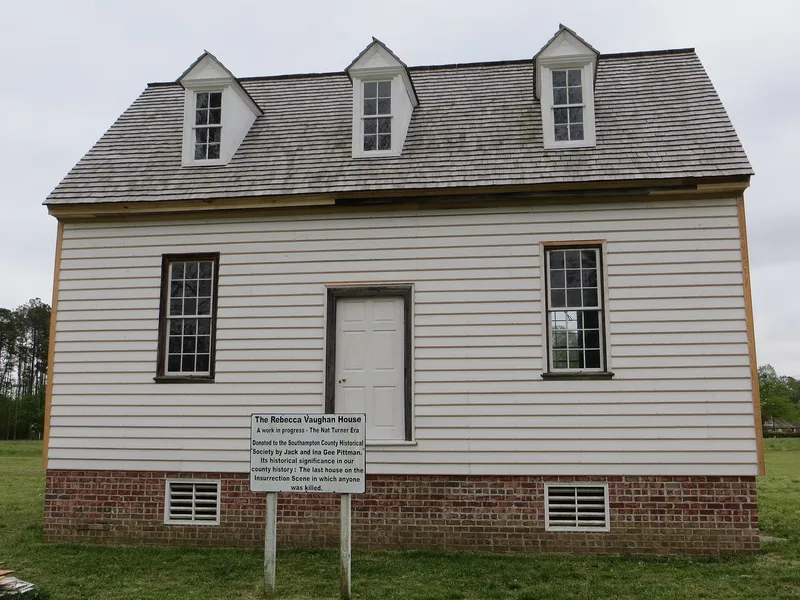

Why it's listed
This small frame dwelling, built around 1800, has four rooms in one and one-half stories, with a central hall, pressed metal shingle roof and five dormers. Original heart pine flooring, pegged and numbered timber framing, and mitered Federal-period trim survive. The house was moved in 2004 from the Vaughan farm, where it sat empty for over fifteen years and faced demolition, to the Southampton Agriculture & Forestry Museum's Heritage Village in Courtland. It was placed on a new handmade-brick foundation and awaits restoration. The house matters because of its link to the 1831 insurrection led by Nat Turner, an enslaved African American. On August 22, 1831, Turner's followers killed Rebecca Vaughan, her son Arthur, an overseer and her niece Ann Eliza here, in the last killings of the revolt. Other sites tied to the events have collapsed or been demolished, making this the only standing building in the county where residents died. The revolt led to harsher slave codes across Virginia.
Significance in brief: The house is tied to the August 1831 Southampton Insurrection led by Nat Turner. It was the last house where Turner's followers killed residents, and it is the only building still standing in the county where residents were killed during the revolt. It meets Criterion A, and Criteria Consideration B because it was moved to prevent demolition.
Machine-generated summary. This summary was generated by a language model from the official nomination document and has not been reviewed line by line by an editor. It may contain errors. Check the source document before relying on any detail. Source: nomination document (PDF). NRHP reference 06000162, listed March 22, 2006. Summary generated October 2026 (model claude-sonnet-5-5, prompt v1.0-2026-10-29, confidence medium).
Key facts
| Address | 26315 Heritage Ln., Courtland |
|---|---|
| County | Southampton County |
| Listed | March 22, 2006 |
| Reference number | 06000162 |
| Resource type | Building |
| Period of significance | ca. 1800-1831 |
| Architectural style | Federal |
| Criteria |
|
| Areas of significance | Social History, Black, Ethnic Heritage-Black |
| Level of significance | Local |
| Status (as stated in the nomination) | Listed as not in use, with restoration work in progress after the 2004 move; exterior restoration, including chimney reconstruction and window, roof and dormer repair, was planned first. |
| Acreage | 3.2 |
| Coordinates | 36.71092, -77.05781 (NPS GIS) |
What listing means for this property
National Register listing is honorary for a privately owned home: it does not by itself restrict what an owner may do with their own money, and it does not require public access. Restrictions come from local landmark or historic-district ordinances, which are separate (how they differ).
Owner-occupied houses are not eligible for the 20% federal rehabilitation tax credit, which applies to income-producing buildings, but many states offer credits for homeowners. Listing also opens the door to preservation easements and to buying a plaque. Start with what listing means for homeowners, renovating a listed house and selling one.
Noted as vacant in the nomination. Nomination documents can be decades old; current status may differ. If you are considering buying an empty listed property, read the due-diligence checklist.
General information, not legal or tax advice. Rules change; confirm with your State Historic Preservation Office or a qualified adviser.
Sources and further reading
- National Park Service, National Register of Historic Places database (snapshot May 2026), reference 06000162.
- Nomination form (PDF, National Archives)
- Wikipedia article (used for cross-checking only; text not reproduced here)
- Wikidata Q15272107
- This listing as JSON
Last updated October 2026. Found an error? See the editorial policy for how to report it.