Sperryville Historic District

Why it's listed
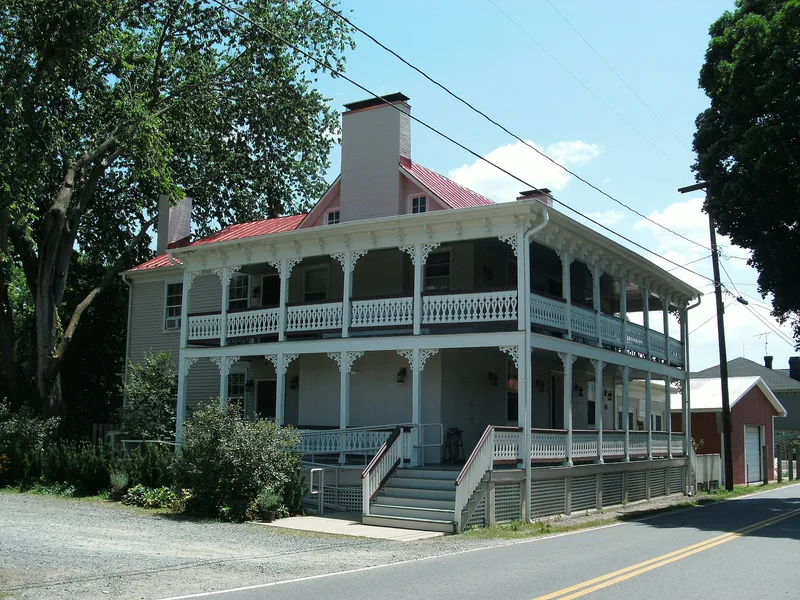
Sperryville is a small crossroads village on a plain between the Thornton River and the northern Blue Ridge hills in Rappahannock County, Virginia. The historic district covers about 38 acres and more than seventy buildings, mostly one- and two-story wood-frame houses. Francis Thornton, Jr. laid out the first lots around 1818-1820, and the earliest surviving houses, with stone chimneys and double front entrances, stand along Route 1001. Growth stayed slow until the Smoot family of Alexandria opened a tannery in 1867. Many of the village's modest houses date from that era, including plain workers' dwellings and shotgun houses set beside larger homes with sawn trim. Three early 20th-century churches, a row of stores, bungalows and white picket fences add to the setting. After the tannery closed in 1918, little new building occurred, so the village keeps its turn-of-the-century character with few modern intrusions. Several houses now serve as antique shops.
Significance in brief: The nomination argues Sperryville is an upper Piedmont crossroads town that has changed little since the 1920s. Growth after the Smoot tannery opened in 1867 produced many simple wooden houses, including workers' housing mixed with more stylish homes influenced by the Romantic Revivals. Few modern intrusions remain, and few villages like it survive in Virginia.
Machine-generated summary. This summary was generated by a language model from the official nomination document and has not been reviewed line by line by an editor. It may contain errors. Check the source document before relying on any detail. Source: nomination document (PDF) · National Archives catalog entry. NRHP reference 83003300, listed February 10, 1983. Summary generated October 2026 (model claude-sonnet-5-5, prompt v1.0-2026-10-29, confidence medium).
Key facts
| Address | VA 522, 600, 1001, and 1002, Sperryville |
|---|---|
| County | Rappahannock County |
| Listed | February 10, 1983 |
| Reference number | 83003300 |
| Resource type | District |
| Architectural style | Late Federal vernacular, Romantic Revival and Victorian influences, with early 20th-century bungalows and churches |
| Areas of significance | Architecture |
| Level of significance | State |
| Status (as stated in the nomination) | Described as having high integrity and virtually free of modern intrusions; houses remain in residential use and several have been adapted as antique shops. |
| Acreage | 38 |
| Coordinates | 38.65727, -78.22623 (NPS GIS) |
What listing means for this property
This is a historic district. Buildings within its boundary are either contributing (they add to the district's significance) or non-contributing. Owners of contributing income-producing buildings can claim the 20% federal rehabilitation tax credit; homeowners should look at state credits. National Register districts impose no design review by themselves; a local historic district ordinance, if one exists, does (the difference explained).
General information, not legal or tax advice. Rules change; confirm with your State Historic Preservation Office or a qualified adviser.
Sources and further reading
- National Park Service, National Register of Historic Places database (snapshot May 2026), reference 83003300.
- Nomination form (PDF, National Archives) — catalog entry
- Wikipedia article (used for cross-checking only; text not reproduced here)
- Wikidata Q15278886
- This listing as JSON
Last updated October 2026. Found an error? See the editorial policy for how to report it.