Pocahontas Island Historic District
Also known as: 123-0114

Why it's listed
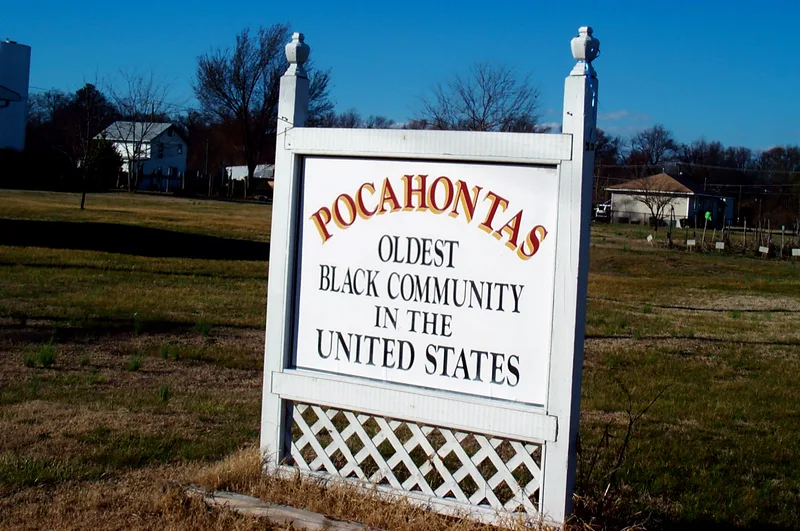
Pocahontas Island, on the northern edge of Petersburg, Virginia, is a small residential neighborhood laid out in 1749 on a grid of streets. A channel cut in 1915 now separates it from Chesterfield County. Most of its frame, one-story houses date from the turn of the twentieth century, and only two buildings are known to predate the Civil War: the brick Federal-style Jarratt House, built about 1819-1820, and a frame double house known locally as the Underground Railroad House. Shotgun houses, side-gable houses and double houses reflect housing built for African Americans. A 1993 tornado destroyed or damaged many homes, leaving more open space than the once densely built area had historically, and newer replacement houses are counted as noncontributing. The district also includes the site of the 1830s Richmond and Petersburg Railroad depot and a former distillery site. It was listed because it records the island's change from a white-dominated town to a largely African American community.
Significance in brief: The nomination presents Pocahontas as a community that shifted from a white-dominated eighteenth-century town to a largely African American neighborhood in the early nineteenth century. Its surviving houses, including double houses and shotgun houses, represent housing built for African Americans. The district also holds archaeological sites such as the Richmond and Petersburg Railroad depot and a distillery, and it shows the long involvement of free Black residents in Petersburg's history.
Machine-generated summary. This summary was generated by a language model from the official nomination document and has not been reviewed line by line by an editor. It may contain errors. Check the source document before relying on any detail. Source: nomination document (PDF) · National Archives catalog entry. NRHP reference 06000977, listed November 3, 2006. Summary generated October 2026 (model claude-sonnet-5-5, prompt v1.0-2026-10-29, confidence medium).
Key facts
| Address | Pocahontas, Witten, Rolfe, Logan, and Sapony Sts., Petersburg (Independent City) |
|---|---|
| County | Petersburg |
| Listed | November 3, 2006 |
| Reference number | 06000977 |
| Resource type | District |
| Architect / builder | William Edward Lee, Jr. (designed the house at 208 Witten Street, 1920s) |
| Architectural style | Early Republic/Federal; Late 19th & Early 20th Century American Movements/Bungalow/Craftsman |
| Areas of significance | Architecture, Archeology-Historic Aboriginal, Archeology-Historic Non-Aboriginal, Ethnic Heritage-Black, Ethnic Heritage-Native American, Social History |
| Level of significance | Local |
| Status (as stated in the nomination) | Primarily a quiet residential neighborhood; many homes were damaged or destroyed by a 1993 tornado and replaced by noncontributing houses. The Jarratt House is in poor condition with boarded windows and doors. |
| Acreage | 40 |
| Coordinates | 37.23946, -77.39913 (NPS GIS) |
What listing means for this property
This is a historic district. Buildings within its boundary are either contributing (they add to the district's significance) or non-contributing. Owners of contributing income-producing buildings can claim the 20% federal rehabilitation tax credit; homeowners should look at state credits. National Register districts impose no design review by themselves; a local historic district ordinance, if one exists, does (the difference explained).
General information, not legal or tax advice. Rules change; confirm with your State Historic Preservation Office or a qualified adviser.
Sources and further reading
- National Park Service, National Register of Historic Places database (snapshot May 2026), reference 06000977.
- Nomination form (PDF, National Archives) — catalog entry
- Wikipedia article (used for cross-checking only; text not reproduced here)
- Wikidata Q7206274
- This listing as JSON
Last updated October 2026. Found an error? See the editorial policy for how to report it.