Barboursville

Why it's listed
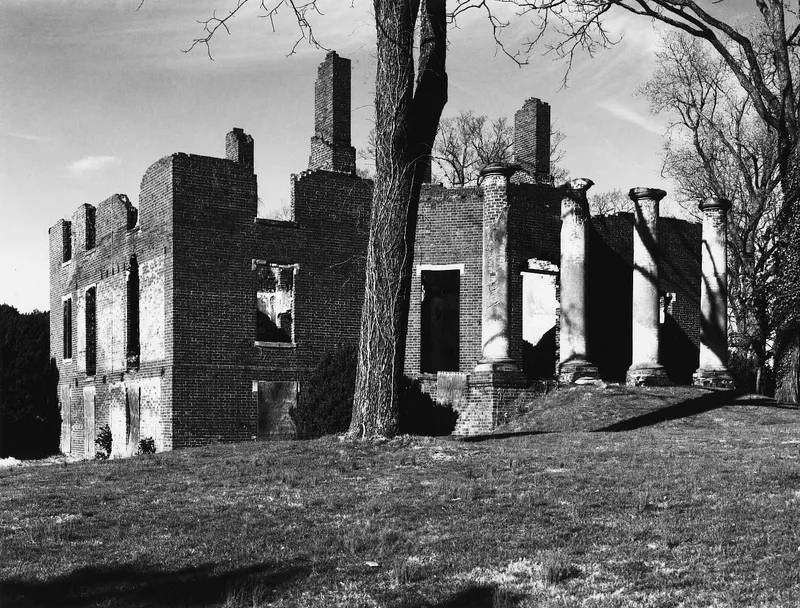
Barboursville in Orange County, Virginia, preserves the ruins of a mansion built for James Barbour around 1822 from designs supplied by Thomas Jefferson. Fire destroyed the house on Christmas Day 1884, leaving the exterior brick walls, interior masonry partitions and portico columns. The house had a Roman Doric portico on the entrance front and an octagonal drawing room projecting on the garden front, echoing Monticello. Jefferson's proposed octagonal dome was omitted during construction. Two service buildings to the north, believed to date from about 1790, now serve as the main residence, and the grounds are known for large boxwood and a partly surviving serpentine garden wall. The property matters for its link to Jefferson, whose surviving drawings can be compared with the standing walls, and for Barbour, who served as Virginia governor, U.S. Senator, Secretary of War and Minister to England, and who is credited with founding the Literary Fund of Virginia.
Significance in brief: The house was designed by Thomas Jefferson and came closer to Monticello in character than any of his other works. Enough walls survive to compare against Jefferson's drawings. It was also the home of James Barbour, a Virginia governor, U.S. Senator, Secretary of War and Minister to England.
Machine-generated summary. This summary was generated by a language model from the official nomination document and has not been reviewed line by line by an editor. It may contain errors. Check the source document before relying on any detail. Source: nomination document (PDF) · National Archives catalog entry. NRHP reference 69000267, listed November 12, 1969. Summary generated October 2026 (model claude-sonnet-5-5, prompt v1.0-2026-10-29, confidence high).
Key facts
| Address | S of jct. of Rtes. 777 and 678, Barboursville |
|---|---|
| County | Orange County |
| Listed | November 12, 1969 |
| Reference number | 69000267 |
| Resource type | Building |
| Architect / builder | Designed by Thomas Jefferson; built by carpenter James Bradley and bricklayer Edward Ancel (?), employed by James Barbour |
| Areas of significance | Politics/Government, Architecture |
| Level of significance | National |
| Status (as stated in the nomination) | The main house is a ruin, overgrown with vines but maintained and generally sound. Two service buildings to the north serve as the main residence. |
| Coordinates | 38.16251, -78.28188 (NPS GIS) |
What listing means for this property
National Register listing is honorary: it recognises significance and does not restrict what a private owner may do without federal money or permits. It unlocks the 20% federal rehabilitation tax credit for income-producing buildings, state credits in many states, and Section 106 review when federal agencies are involved. See what listing means in practice.
General information, not legal or tax advice. Rules change; confirm with your State Historic Preservation Office or a qualified adviser.
Sources and further reading
- National Park Service, National Register of Historic Places database (snapshot May 2026), reference 69000267.
- Nomination form (PDF, National Archives) — catalog entry
- Wikipedia article (used for cross-checking only; text not reproduced here)
- Wikidata Q4859734
- This listing as JSON
Last updated October 2026. Found an error? See the editorial policy for how to report it.