Blackstone Historic District
Also known as: DHR File No. 142-7; See Also:Schwartz Tavern
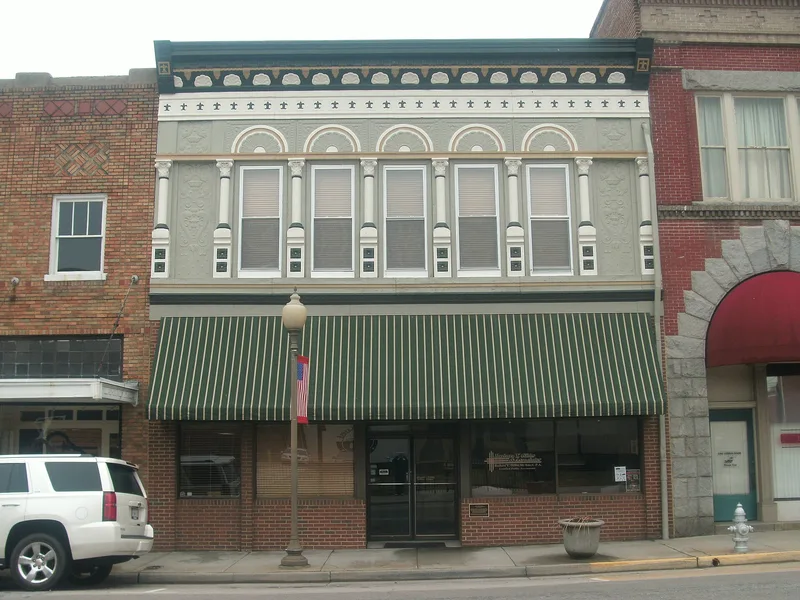

Why it's listed
Blackstone's historic district preserves the core of a Southside Virginia town that began as an eighteenth-century crossroads known as Black's and White's, after two competing taverns. The ca. 1790 Schwartz Tavern, now restored, is the earliest landmark. Growth accelerated after the Southside Railroad arrived in the 1850s, and the town became a commercial and transportation center. Main and Broad Streets hold late-nineteenth- and early-twentieth-century storefronts with Romanesque Revival, Italianate, cast-metal and Art Deco details, including the First National Bank designed by Richmond architect D. Wiley Anderson. Fires in 1902, 1928 and 1964 shaped the downtown, and the 1928 losses were quickly rebuilt. South and west of downtown, the Blackstone Land and Improvement Company developed neighborhoods of Queen Anne, Colonial Revival and Bungalow houses, many built by local contractors such as R. W. Cobbs and Joseph W. Crowder. Four turn-of-the-century churches and the 1922 former Blackstone College for Girls complete the district, which reflects architectural trends from about 1790 to 1940.
Significance in brief: The district is significant under Criterion A as a transportation and commercial center that grew from an eighteenth-century crossroads settlement and expanded after the Southside Railroad arrived in the 1850s. It is significant under Criterion C for its Victorian commercial blocks, Queen Anne and Colonial Revival houses, and early-twentieth-century civic, academic and church architecture.
Machine-generated summary. This summary was generated by a language model from the official nomination document and has not been reviewed line by line by an editor. It may contain errors. Check the source document before relying on any detail. Source: nomination document (PDF) · National Archives catalog entry. NRHP reference 90002174, listed January 25, 1991. Summary generated October 2026 (model claude-sonnet-5-5, prompt v1.0-2026-10-29, confidence high).
Key facts
| Address | Roughly bounded by Mann, Dillard, Tavern, S. High, Oak, Eighth and Freeman Sts. and the Norfolk and Western RR tracks, Blackstone |
|---|---|
| County | Nottoway County |
| Listed | January 25, 1991 |
| Reference number | 90002174 |
| Resource type | District |
| Period of significance | 1790s to 1940 |
| Architect / builder | Fred A. Bishop (architect); D. Wiley Anderson (architect); R. W. Cobbs (builder); Joseph Wesley Crowder (builder); J. E. McDaniel (architect/builder) |
| Architectural style | Queen Anne; Romanesque Revival; Late Gothic Revival; Victorian Italianate; Beaux Arts; Colonial Revival; Bungalow/Craftsman; Art Deco |
| Criteria |
|
| Areas of significance | Commerce, Transportation, Architecture |
| Level of significance | State |
| Status (as stated in the nomination) | Many commercial buildings have been restored as part of a downtown revitalization, and the Schwartz Tavern has been restored. The Blackstone Public School Complex was lost to arson in the 1970s. |
| Acreage | 208 |
| Coordinates | 37.07643, -78.00541 (NPS GIS) |
What listing means for this property
This is a historic district. Buildings within its boundary are either contributing (they add to the district's significance) or non-contributing. Owners of contributing income-producing buildings can claim the 20% federal rehabilitation tax credit; homeowners should look at state credits. National Register districts impose no design review by themselves; a local historic district ordinance, if one exists, does (the difference explained).
General information, not legal or tax advice. Rules change; confirm with your State Historic Preservation Office or a qualified adviser.
Sources and further reading
- National Park Service, National Register of Historic Places database (snapshot May 2026), reference 90002174.
- Nomination form (PDF, National Archives) — catalog entry
- Wikipedia article (used for cross-checking only; text not reproduced here)
- Wikidata Q15199627
- This listing as JSON
Last updated October 2026. Found an error? See the editorial policy for how to report it.