Lafayette Historic District
Also known as: DHR file # 60-418

Why it's listed
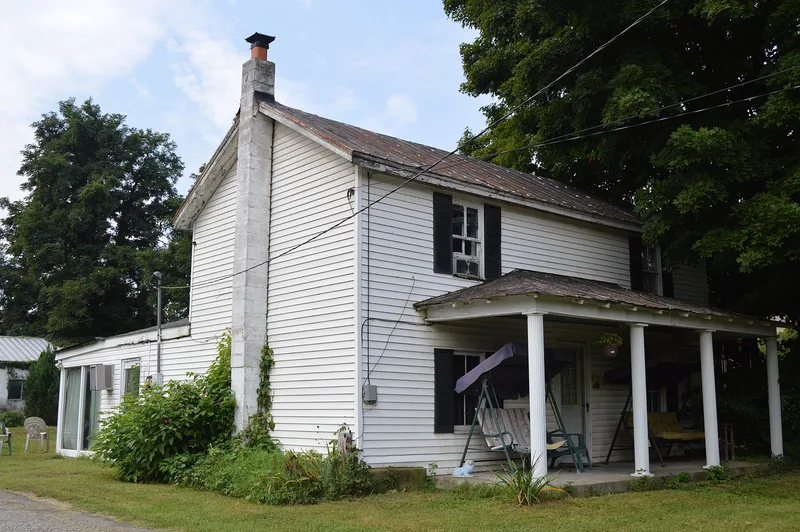
Lafayette is a small village where the north and south forks of the Roanoke River meet. Laid out in the 1820s near a gristmill and established as a town in 1828, it grew quickly in the 1830s and was the most populous place between Christiansburg and Salem. The Southwestern Turnpike bypassed it in 1846, and growth slowed. The twelve-acre district keeps four square blocks of its original plan, with houses mostly of frame construction from about 1830 to 1940. The oldest are the Pepper House, containing a log single-pen core built before 1829, and the Preston Waskey House, probably from 1829. The brick Methodist church of about 1847 stands beside the site of a former muster ground and may have been built on a meetinghouse plan unique in the county. Two small stores, one of which served as the post office until 1985, also survive. The district was listed for its architecture and as an example of an early turnpike town.
Significance in brief: The district is significant under Criterion C because its buildings show the architectural development of the town and the gradual infill of its lots over more than a century. It is significant under Criterion A for exploration/settlement as a good example of an early nineteenth-century turnpike town that retains much of its original plan, including the site of an unusual square or muster ground.
Machine-generated summary. This summary was generated by a language model from the official nomination document and has not been reviewed line by line by an editor. It may contain errors. Check the source document before relying on any detail. Source: nomination document (PDF) · National Archives catalog entry. NRHP reference 90002005, listed January 10, 1991. Summary generated October 2026 (model claude-sonnet-5-5, prompt v1.0-2026-10-29, confidence high).
Key facts
| Address | Roughly, High St. from Main to Washington Sts., Main from High to Water Sts. and Church St. from Main to Washington, Lafayette |
|---|---|
| County | Montgomery County |
| Listed | January 10, 1991 |
| Reference number | 90002005 |
| Resource type | District |
| Period of significance | ca. 1825-1940 |
| Architectural style | Vernacular; single-pen, center-passage, nave plan and 20th-century commercial forms |
| Criteria |
|
| Areas of significance | Exploration/Settlement, Architecture |
| Level of significance | Local |
| Status (as stated in the nomination) | Houses are described as nearly all owner occupied and well maintained; the Sid Butt Barbershop has been restored as a pottery shop and studio. The form lists current functions including vacant/not in use. |
| Acreage | 12 |
| Coordinates | 37.23504, -80.21059 (NPS GIS) |
What listing means for this property
This is a historic district. Buildings within its boundary are either contributing (they add to the district's significance) or non-contributing. Owners of contributing income-producing buildings can claim the 20% federal rehabilitation tax credit; homeowners should look at state credits. National Register districts impose no design review by themselves; a local historic district ordinance, if one exists, does (the difference explained).
General information, not legal or tax advice. Rules change; confirm with your State Historic Preservation Office or a qualified adviser.
Sources and further reading
- National Park Service, National Register of Historic Places database (snapshot May 2026), reference 90002005.
- Nomination form (PDF, National Archives) — catalog entry
- Wikipedia article (used for cross-checking only; text not reproduced here)
- Wikidata Q14712681
- This listing as JSON
Last updated October 2026. Found an error? See the editorial policy for how to report it.