Long Grass
Also known as: VDHR File No. 58-185
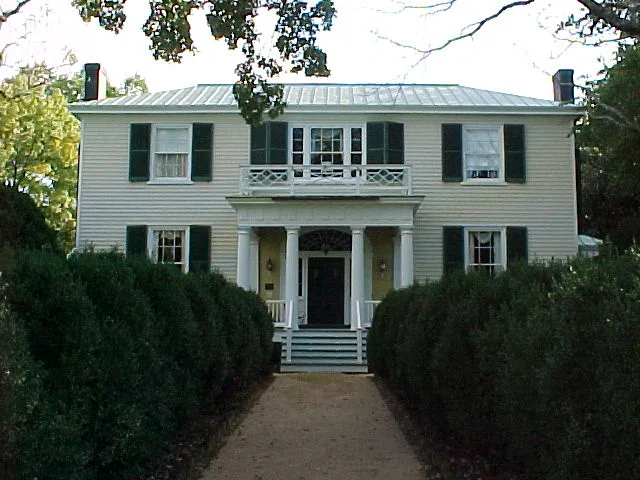

Why it's listed
Long Grass is a farm of about forty acres on the shore of the John H. Kerr Reservoir in Mecklenburg County, Virginia, farmed by generations of the Tarry family since the early 1800s. Its two-story frame house began as a small hall-parlor dwelling around 1800. A formal north wing was added about 1840, and a full second story was added to the older wing in the 1850s. Both changes are attributed to the regional builder Jacob W. Holt, and the porches show the shift in his style between the two decades. Around the house stand a log schoolhouse, a kitchen and laundry, a smokehouse and an ice house. Farther out are a livestock barn and carriage house, a log tenant house, a pack house with an ordering pit, and two tobacco barns. George P. Tarry ran the 3,000-acre farm around 1900. The property was recognized for its agricultural and architectural importance between about 1800 and 1945.
Significance in brief: The farm is significant for agriculture because its outbuildings illustrate the operation of one of the area's most prosperous late-nineteenth-century farms. It is significant for architecture because of the house's early-nineteenth-century detailing and Greek Revival work attributed to builder Jacob W. Holt. The outbuildings also have architectural value. Significance is local.
Machine-generated summary. This summary was generated by a language model from the official nomination document and has not been reviewed line by line by an editor. It may contain errors. Check the source document before relying on any detail. Source: nomination document (PDF) · National Archives catalog entry. NRHP reference 95000894, listed July 21, 1995. Summary generated October 2026 (model claude-sonnet-5-5, prompt v1.0-2026-10-29, confidence high).
Key facts
| Address | VA 826, Eppes Fork |
|---|---|
| County | Mecklenburg County |
| Listed | July 21, 1995 |
| Reference number | 95000894 |
| Resource type | District |
| Period of significance | ca. 1800-1945 |
| Architect / builder | Jacob W. Holt (attributed builder of the Greek Revival additions) |
| Architectural style | Greek Revival |
| Criteria |
|
| Areas of significance | Agriculture, Architecture |
| Level of significance | Local |
| Status (as stated in the nomination) | The property includes a main house, a schoolhouse modified as a dwelling, and farm buildings. Current functions listed include single dwelling, secondary dwelling, agricultural field and animal facility. |
| Acreage | 40 |
| Coordinates | 36.55472, -78.34481 (NPS GIS) |
What listing means for this property
This is a historic district. Buildings within its boundary are either contributing (they add to the district's significance) or non-contributing. Owners of contributing income-producing buildings can claim the 20% federal rehabilitation tax credit; homeowners should look at state credits. National Register districts impose no design review by themselves; a local historic district ordinance, if one exists, does (the difference explained).
General information, not legal or tax advice. Rules change; confirm with your State Historic Preservation Office or a qualified adviser.
Sources and further reading
- National Park Service, National Register of Historic Places database (snapshot May 2026), reference 95000894.
- Nomination form (PDF, National Archives) — catalog entry
- Wikipedia article (used for cross-checking only; text not reproduced here)
- Wikidata Q6672563
- This listing as JSON
Last updated October 2026. Found an error? See the editorial policy for how to report it.