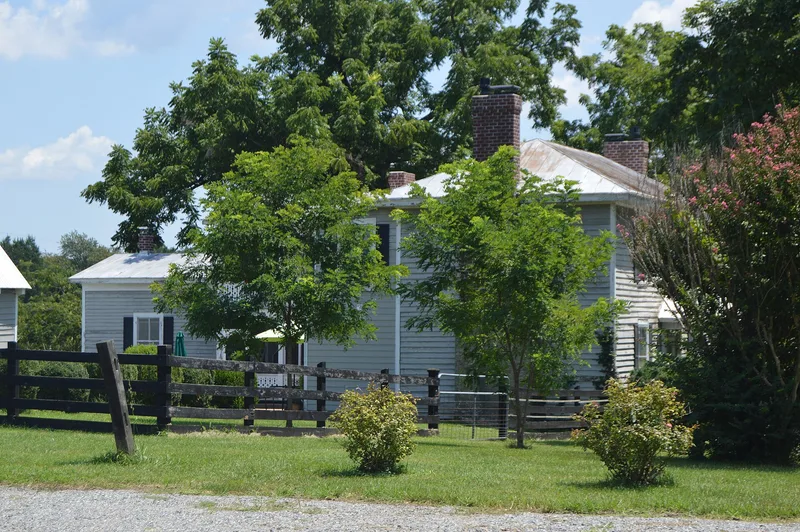
Harris-Poindexter House and Store

Why it's listed
Beside the CSX railroad tracks in the village of Fredericks Hall, this Louisa County farm complex centers on a two-story Greek Revival farmhouse built about 1837 and a one-story frame store rebuilt about 1865 on the foundation of an earlier store burned late in the Civil War. Thirteen additional buildings, including barns, a smokehouse, a stable, a corn crib, a milk house and a timber-frame grain mill, date from the late nineteenth to mid-twentieth century. The Harris family, who developed the village, are linked to the original buildings. Peyton Talley and Horatio Hancock bought the house and store in 1861. Edward Poindexter acquired the property in 1893, and he and his son Emmett ran the farm and the store, selling groceries, meats, seeds and dry goods, until 1945. The house keeps its heart pine floors, original mantels and fine millwork. The property was listed for its role in local commerce and its well-preserved vernacular architecture.
Significance in brief: The complex is argued to be locally significant under Criterion A in Commerce and Criterion C in Architecture. The farm represents the agricultural economy that supported rural counties like Louisa, and the store is characteristic of early rural commercial establishments. It served the village of Fredericks Hall and was run by the Poindexter family for more than sixty years.
Machine-generated summary. This summary was generated by a language model from the official nomination document and has not been reviewed line by line by an editor. It may contain errors. Check the source document before relying on any detail. Source: nomination document (PDF) · National Archives catalog entry. NRHP reference 02000534, listed May 22, 2002. Summary generated October 2026 (model claude-sonnet-5-5, prompt v1.0-2026-10-29, confidence medium).
Key facts
| Address | 81 Tavern Rd., Mineral |
|---|---|
| County | Louisa County |
| Listed | May 22, 2002 |
| Reference number | 02000534 |
| Resource type | Building |
| Period of significance | 1837-1945 |
| Architect / builder | unknown |
| Architectural style | Greek Revival/Commercial Vernacular |
| Criteria |
|
| Areas of significance | Architecture, Commerce |
| Level of significance | Local |
| Status (as stated in the nomination) | The store and the mill are vacant and deteriorated; the house is in use as a dwelling and has been well maintained, along with most outbuildings. |
| Acreage | 36.2 |
| Coordinates | 37.99176, -77.81848 (NPS GIS) |
What listing means for this property
National Register listing is honorary for a privately owned home: it does not by itself restrict what an owner may do with their own money, and it does not require public access. Restrictions come from local landmark or historic-district ordinances, which are separate (how they differ).
Owner-occupied houses are not eligible for the 20% federal rehabilitation tax credit, which applies to income-producing buildings, but many states offer credits for homeowners. Listing also opens the door to preservation easements and to buying a plaque. Start with what listing means for homeowners, renovating a listed house and selling one.
General information, not legal or tax advice. Rules change; confirm with your State Historic Preservation Office or a qualified adviser.
Sources and further reading
- National Park Service, National Register of Historic Places database (snapshot May 2026), reference 02000534.
- Nomination form (PDF, National Archives) — catalog entry
- Wikipedia article (used for cross-checking only; text not reproduced here)
- Wikidata Q14712492
- This listing as JSON
Last updated October 2026. Found an error? See the editorial policy for how to report it.