Slash Church
Also known as: Upper Church; St. Paul's Parish

Why it's listed
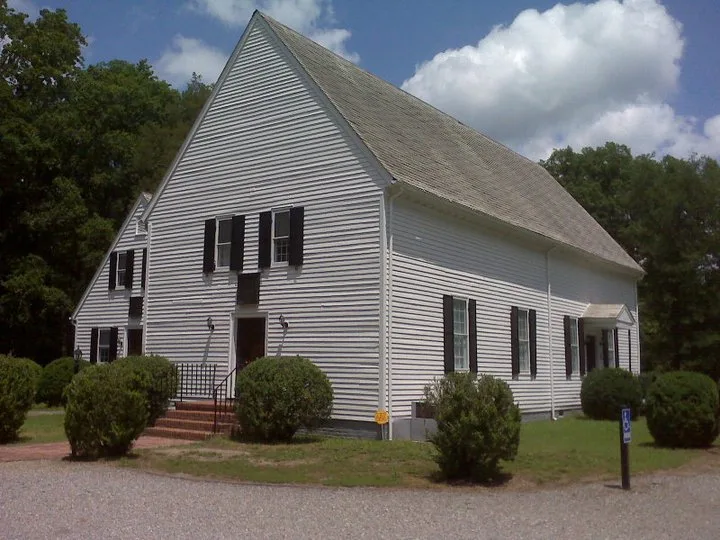
Slash Church is a white clapboarded frame building near Ashland in Hanover County, Virginia. Built in 1729 by Thomas Pinchbeck and Edward Chambers, it served as the Upper Church of St. Paul's Parish, which was formed in 1704. The rectangular structure has a steep gable roof, a modillion cornice and double doors on three sides. Some clapboarding, cornice sections, the west doors and window sills are believed to be colonial, as is much of the original framing, including an unusual roof frame with triangular vertical supports. A 1970 fire damaged the interior, which was rebuilt to match the lost wainscoting and walls. It is one of about six surviving frame colonial churches in Virginia. Patrick Henry, Dolley Madison and Henry Clay are believed to have worshipped here, and Patrick Henry's uncle was rector for forty years. After the Disestablishment the church was shared by Methodists and Disciples of Christ, and since 1842 it has belonged to the latter. The name comes from nearby swampy land called the slashes.
Significance in brief: It survives as one of only about half a dozen frame colonial churches in Virginia. Its history is closely tied to the local area, and Patrick Henry, Dolley Madison and Henry Clay are believed to have attended. Patrick Henry's uncle of the same name served as rector for forty years in the eighteenth century.
Machine-generated summary. This summary was generated by a language model from the official nomination document and has not been reviewed line by line by an editor. It may contain errors. Check the source document before relying on any detail. Source: nomination document (PDF) · National Archives catalog entry. NRHP reference 72001399, listed September 22, 1972. Summary generated October 2026 (model claude-sonnet-5-5, prompt v1.0-2026-10-29, confidence high).
Key facts
| Address | VA 656, N of jct. with VA 657, Ashland |
|---|---|
| County | Hanover County |
| Listed | September 22, 1972 |
| Reference number | 72001399 |
| Resource type | Building |
| Period of significance | 18th Century (specific date 1729) |
| Architect / builder | Thomas Pinchbeck and Edward Chambers |
| Areas of significance | Architecture, Religion |
| Level of significance | State |
| Status (as stated in the nomination) | In good condition and occupied, in religious use. The interior was damaged by fire and water in 1970 and rebuilt to resemble the original; a modern addition is connected by a passageway. |
| Acreage | 10 |
| Within district | Brown Grove Rural Historic District |
| Coordinates | 37.71889, -77.41474 (NPS GIS) |
What listing means for this property
Religious properties are listed for their architectural or historical significance, not their religious use. Listing is honorary and does not restrict the congregation's use of the building. The federal rehabilitation credit is generally unavailable unless part of the building is income-producing; some state programmes and preservation grants do cover religious buildings. Federal funding or permits trigger Section 106 review.
General information, not legal or tax advice. Rules change; confirm with your State Historic Preservation Office or a qualified adviser.
Sources and further reading
- National Park Service, National Register of Historic Places database (snapshot May 2026), reference 72001399.
- Nomination form (PDF, National Archives) — catalog entry
- Wikipedia article (used for cross-checking only; text not reproduced here)
- Wikidata Q14713211
- This listing as JSON
Last updated October 2026. Found an error? See the editorial policy for how to report it.