Buckshoal Farm

Why it's listed
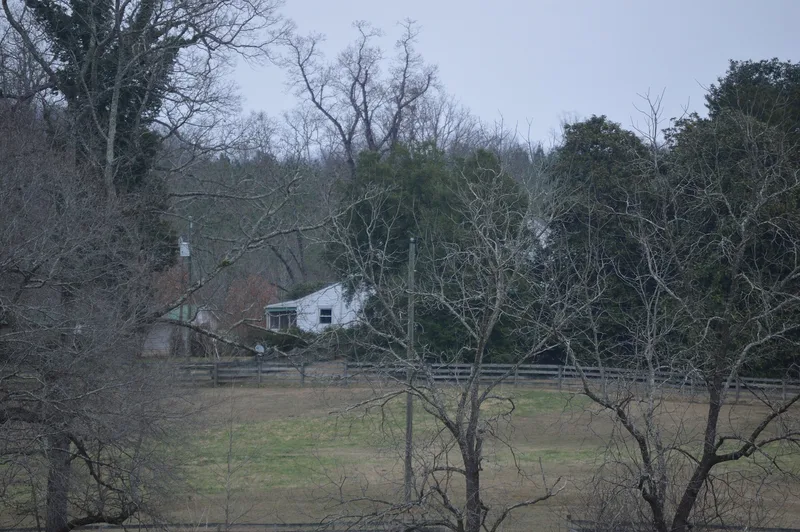
Buckshoal Farm is a Halifax County farmhouse near Omega, Virginia, that grew in stages over roughly 150 years. Its oldest part is a two-story log section under clapboard, built in the early nineteenth century. A larger frame section with a bracketed Italianate cornice was added in 1841, and around 1921 a southern ell with a hexagonal bay was built, along with porch and kitchen changes. A log well-house and a frame shed complete the nominated group on about 1.75 acres. The property matters for two reasons. William M. Tuck was born here in 1896 and returned often during a career as delegate, state senator, lieutenant governor, governor and congressman. As governor he insisted on the Right-to-Work Act of 1947. The house also illustrates how local farmhouses expanded from back to front as needs and tastes changed, and its surviving log core is considered a rare survival.
Significance in brief: The nomination stresses its association with William M. Tuck, born there in 1896, who served as Virginia Governor (1946-50) and U.S. Congressman (1953-69) and pushed through the Right-to-Work Act of 1947. It is also locally significant as an example of a Halifax County farmhouse that grew by additions, retaining a rare early log section.
Machine-generated summary. This summary was generated by a language model from the official nomination document and has not been reviewed line by line by an editor. It may contain errors. Check the source document before relying on any detail. Source: nomination document (PDF) · National Archives catalog entry. NRHP reference 87001473, listed September 16, 1987. Summary generated October 2026 (model claude-sonnet-5-5, prompt v1.0-2026-10-29, confidence high).
Key facts
| Address | VA 737, Omega |
|---|---|
| County | Halifax County |
| Listed | September 16, 1987 |
| Reference number | 87001473 |
| Resource type | Building |
| Period of significance | early 19th C. to 1969 |
| Architectural style | Vernacular, with Italianate and Eastlake elements |
| Criteria |
|
| Areas of significance | Politics/Government, Architecture |
| Level of significance | State |
| Status (as stated in the nomination) | Marked unoccupied and private residence on the form; after Tuck's death in 1983 the property passed to descendants, who rent out the farm. |
| Acreage | 1.8 |
| Coordinates | 36.64257, -78.77053 (NPS GIS) |
What listing means for this property
National Register listing is honorary for a privately owned home: it does not by itself restrict what an owner may do with their own money, and it does not require public access. Restrictions come from local landmark or historic-district ordinances, which are separate (how they differ).
Owner-occupied houses are not eligible for the 20% federal rehabilitation tax credit, which applies to income-producing buildings, but many states offer credits for homeowners. Listing also opens the door to preservation easements and to buying a plaque. Start with what listing means for homeowners, renovating a listed house and selling one.
General information, not legal or tax advice. Rules change; confirm with your State Historic Preservation Office or a qualified adviser.
Sources and further reading
- National Park Service, National Register of Historic Places database (snapshot May 2026), reference 87001473.
- Nomination form (PDF, National Archives) — catalog entry
- Wikipedia article (used for cross-checking only; text not reproduced here)
- Wikidata Q14712103
- This listing as JSON
Last updated October 2026. Found an error? See the editorial policy for how to report it.