Fredericksburg Historic District
Also known as: Fredericksburg Preservation District; See Also:Brompton; Chimn

Why it's listed
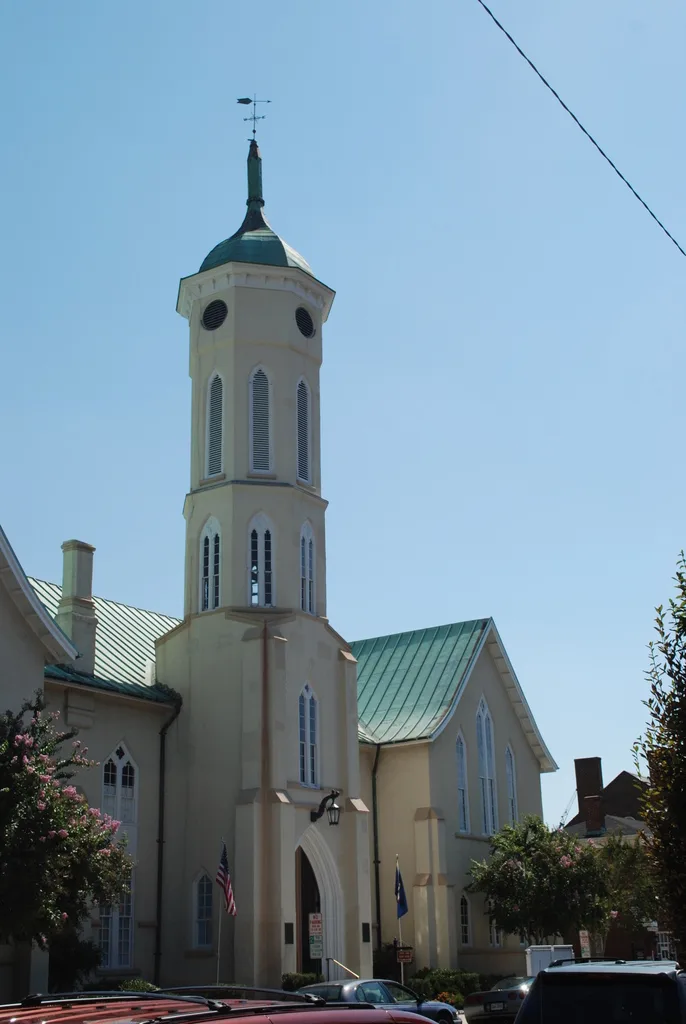
Forty blocks of Fredericksburg, Virginia, along the west bank of the Rappahannock River, make up this historic district of about 200 acres. Five streets run parallel to the river, and the area holds the downtown commercial core, city hall, several churches, the train station and the city's oldest residential neighborhoods. Notable buildings include the Sentry Box, the Rising Sun Tavern, the Mary Washington House, the 1851 Court House designed by James Renwick, and the 1814 City Hall over the old market. The town was settled in 1671, chartered in 1727 and became a busy trading center. Revolutionary figures such as Hugh Mercer, James Monroe and Fielding Lewis were associated with it. Despite modern intrusions, it keeps a large group of eighteenth and nineteenth century buildings. A later extension recognizes sixteen early twentieth century Colonial Revival buildings, including the post office, railroad station, hospital and bank, which echo the scale and materials of the older Georgian and Federal architecture.
Significance in brief: The nomination argues that Fredericksburg, settled in 1671 and chartered in 1727, played a distinguished role in Virginia's history, with many Revolutionary-era patriots tied to the town. It retains an important group of 18th- and 19th-century buildings and remains a relatively undisturbed historic community. A later extension adds the 20th century, citing Colonial Revival buildings that fit the district's early character.
Machine-generated summary. This summary was generated by a language model from the official nomination document and has not been reviewed line by line by an editor. It may contain errors. Check the source document before relying on any detail. Source: nomination document (PDF) · National Archives catalog entry. NRHP reference 71001053, listed September 22, 1971. Summary generated October 2026 (model claude-sonnet-5-5, prompt v1.0-2026-10-29, confidence medium).
Key facts
| Address | Roughly bounded by Rappahannock River, Hazel Run, Prince Edward and Canal Sts., Fredericksburg (Independent City) |
|---|---|
| County | Fredericksburg |
| Listed | September 22, 1971 |
| Reference number | 71001053 |
| Resource type | District |
| Architect / builder | James Renwick, architect, and W.M. Baggot, builder (Fredericksburg Court House, 1851); Heflin and Sterns (railroad station); John Knox Taylor (former post office); Wesley Bessell and Philip Stearn (Mary Washington Hospital) |
| Architectural style | Georgian, Federal, Gothic Revival, Romanesque Revival and Colonial Revival buildings |
| Areas of significance | Community Planning and Development, Architecture |
| Level of significance | National |
| Status (as stated in the nomination) | Listed as occupied and in good condition, though altered; the district mixes commercial, residential, government and religious uses. |
| Acreage | 200 |
| Coordinates | 38.30020, -77.46998 (NPS GIS) |
What listing means for this property
This is a historic district. Buildings within its boundary are either contributing (they add to the district's significance) or non-contributing. Owners of contributing income-producing buildings can claim the 20% federal rehabilitation tax credit; homeowners should look at state credits. National Register districts impose no design review by themselves; a local historic district ordinance, if one exists, does (the difference explained).
General information, not legal or tax advice. Rules change; confirm with your State Historic Preservation Office or a qualified adviser.
Sources and further reading
- National Park Service, National Register of Historic Places database (snapshot May 2026), reference 71001053.
- Nomination form (PDF, National Archives) — catalog entry
- Wikidata Q97097735
- This listing as JSON
Last updated October 2026. Found an error? See the editorial policy for how to report it.