Hopewell Friends Meetinghouse

Why it's listed
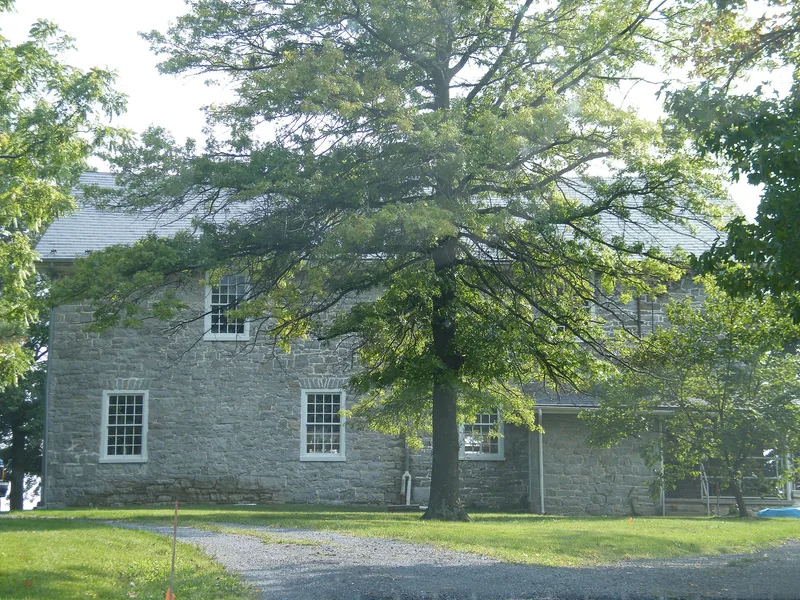
Hopewell Friends Meeting House is a two-story limestone Quaker place of worship near Clear Brook in northern Frederick County, Virginia. Its eastern half was completed in 1761 by builder Thomas McClun, who was paid 68 pounds. Between 1788 and 1794 the building was doubled in size with a western addition that mirrors the original facade. The coursed rubble walls, stone voussoirs over the first-floor openings and plain plastered interior reflect Quaker simplicity. Inside are a tiered gallery and early benches with scrolled ends. The meeting grew from a settlement founded in 1734 by Quakers moving south from Pennsylvania, led by Alexander Ross. A schism in 1827-1828 led to a partition dividing the interior, which was removed when the factions reunited in 1910. That year the weakened east wall was rebuilt with its original stones. The meeting has used the building continuously since 1761, and a walled burying ground adjoins it. The building is considered an early example of Pennsylvania-influenced stone architecture in the Valley of Virginia.
Significance in brief: It is one of the oldest church buildings in the region and a monument to Virginia's Quaker heritage. It is an early example of the austere stone architecture brought into the Valley of Virginia by Pennsylvania migrants. It has been in continuous religious use since 1761 and is tied to the founding of the Hopewell Quaker settlement.
Machine-generated summary. This summary was generated by a language model from the official nomination document and has not been reviewed line by line by an editor. It may contain errors. Check the source document before relying on any detail. Source: nomination document (PDF) · National Archives catalog entry. NRHP reference 80004190, listed March 28, 1980. Summary generated October 2026 (model claude-sonnet-5-5, prompt v1.0-2026-10-29, confidence high).
Key facts
| Address | W of Clear Brook off VA 672, Clear Brook |
|---|---|
| County | Frederick County |
| Listed | March 28, 1980 |
| Reference number | 80004190 |
| Resource type | Building |
| Period of significance | 1761, 1794 |
| Architect / builder | Thomas McClun (original portion) |
| Areas of significance | Architecture, Religion |
| Level of significance | State |
| Status (as stated in the nomination) | In continuous religious use since 1761; condition listed as excellent/good and the property is occupied. |
| Acreage | 2.5 |
| Coordinates | 39.25651, -78.11496 (NPS GIS) |
What listing means for this property
Religious properties are listed for their architectural or historical significance, not their religious use. Listing is honorary and does not restrict the congregation's use of the building. The federal rehabilitation credit is generally unavailable unless part of the building is income-producing; some state programmes and preservation grants do cover religious buildings. Federal funding or permits trigger Section 106 review.
General information, not legal or tax advice. Rules change; confirm with your State Historic Preservation Office or a qualified adviser.
Sources and further reading
- National Park Service, National Register of Historic Places database (snapshot May 2026), reference 80004190.
- Nomination form (PDF, National Archives) — catalog entry
- Wikipedia article (used for cross-checking only; text not reproduced here)
- Wikidata Q5900345
- This listing as JSON
Last updated October 2026. Found an error? See the editorial policy for how to report it.