Burwell-Holland House

Why it's listed
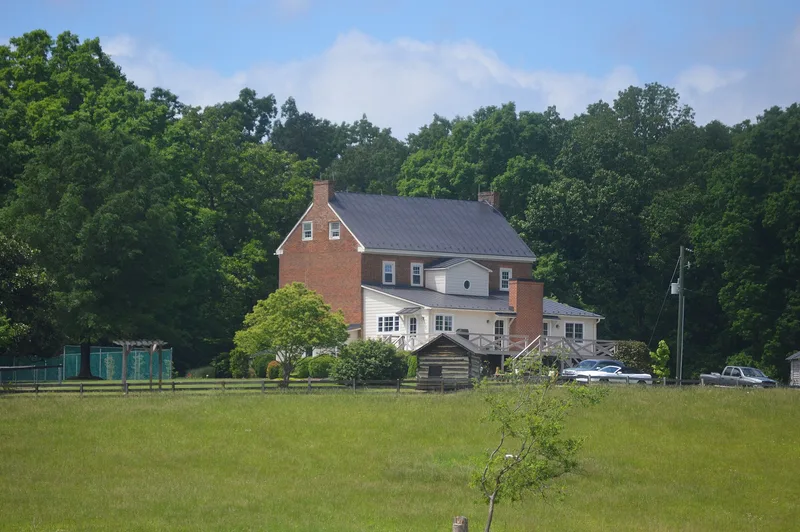
Built in 1798 on a knoll at the base of Jack's Mountain in Glade Hill, this two-story Federal style brick house was the center of a plantation of about 3,000 acres created by Col. Lewis Burwell. The bricks were probably made on the property by enslaved workers. The house has a center hall plan, a full basement, gable-end chimneys, carved mantels, wainscoting and splayed window jambs reflecting Thomas Jefferson's influence. A frame addition was built at the rear in 1976, and eight outbuildings survive, including log structures from the early 1800s. It matters as one of the oldest remaining residences in the county and a rare surviving frontier plantation house built by Tidewater families moving west. It is also tied to William Armistead Burwell, who served in the Virginia General Assembly, as secretary to Jefferson, and as Franklin County's first Congressman. The Holland family has owned it since 1850.
Significance in brief: The nomination argues significance under Criterion C as one of a handful of substantial brick frontier plantation houses in the area, with its original layout, brickwork and splayed windows intact. It argues the strongest case under Criterion B for its link to William Armistead Burwell, a Virginia legislator, the first Congressman from Franklin County, and a personal secretary to President Thomas Jefferson.
Machine-generated summary. This summary was generated by a language model from the official nomination document and has not been reviewed line by line by an editor. It may contain errors. Check the source document before relying on any detail. Source: nomination document (PDF) · National Archives catalog entry. NRHP reference 02000624, listed June 6, 2002. Summary generated October 2026 (model claude-sonnet-5-5, prompt v1.0-2026-10-29, confidence medium).
Key facts
| Address | 600 Jacks Mountain Rd., Glade Hill |
|---|---|
| County | Franklin (city and county) |
| Listed | June 6, 2002 |
| Reference number | 02000624 |
| Resource type | Building |
| Architectural style | Early Republic/Federal |
| Criteria |
|
| Areas of significance | Politics/Government, Architecture |
| Level of significance | Local |
| Status (as stated in the nomination) | Continuously occupied by the Holland family since 1850 except 1967-1975; the 1798 section was restored in 1976 and the parcel remains a working tobacco and dairy farm. |
| Acreage | 26.1 |
| Coordinates | 36.97718, -79.74291 (NPS GIS) |
What listing means for this property
National Register listing is honorary for a privately owned home: it does not by itself restrict what an owner may do with their own money, and it does not require public access. Restrictions come from local landmark or historic-district ordinances, which are separate (how they differ).
Owner-occupied houses are not eligible for the 20% federal rehabilitation tax credit, which applies to income-producing buildings, but many states offer credits for homeowners. Listing also opens the door to preservation easements and to buying a plaque. Start with what listing means for homeowners, renovating a listed house and selling one.
General information, not legal or tax advice. Rules change; confirm with your State Historic Preservation Office or a qualified adviser.
Sources and further reading
- National Park Service, National Register of Historic Places database (snapshot May 2026), reference 02000624.
- Nomination form (PDF, National Archives) — catalog entry
- Wikipedia article (used for cross-checking only; text not reproduced here)
- Wikidata Q14712113
- This listing as JSON
Last updated October 2026. Found an error? See the editorial policy for how to report it.