Huntley

Why it's listed
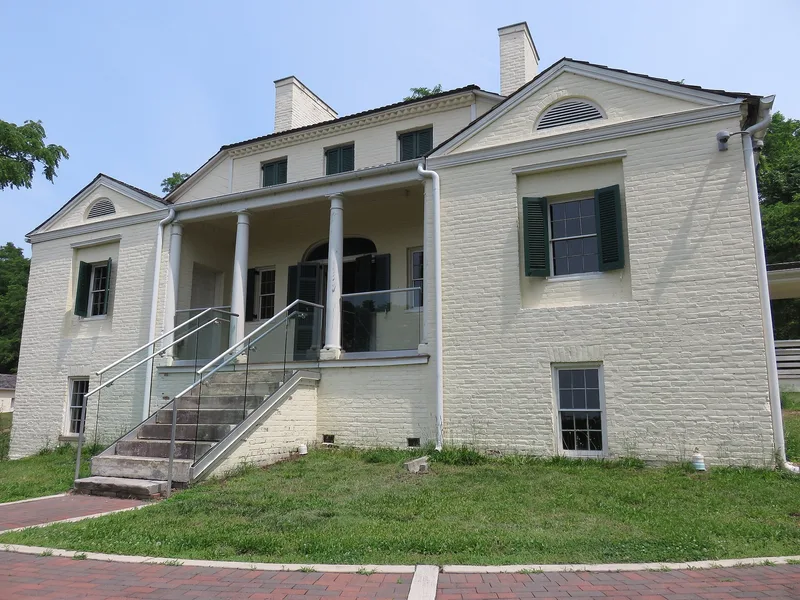
Huntley is a brick country house and farm complex near Alexandria, Virginia, built around 1820 on a knoll overlooking Hybla Valley and the Potomac River. Thomson Francis Mason, a grandson of George Mason IV of Gunston Hall, built it as a secondary residence. The H-shaped Early Federal house rises three stories on the south and has pedimented wings, mousetooth brick cornices, and an elliptical fanlight over the entrance. Inside, corner-block door and window trim and detailed mantels show the quality of its craftsmanship. A full basement adapts the design to the sloping site. Surviving outbuildings include a tenant house, a combined necessary and storage house, a root cellar, a domed brick ice house and a springhouse. The design suggests a trained architect, and one author has compared it to the work of George Hadfield. Its significance rests on its architecture, its Mason family ties and its largely intact farm setting.
Significance in brief: The nomination argues Huntley is a notable example of early nineteenth century architecture and of a country house built by a city dweller. It was a Mason family house, and its farm complex of outbuildings is relatively complete and well sited. Its refined design suggests a trained architect, possibly George Hadfield.
Machine-generated summary. This summary was generated by a language model from the official nomination document and has not been reviewed line by line by an editor. It may contain errors. Check the source document before relying on any detail. Source: nomination document (PDF) · National Archives catalog entry. NRHP reference 72001392, listed November 3, 1972. Summary generated October 2026 (model claude-sonnet-5-5, prompt v1.0-2026-10-29, confidence high).
Key facts
| Address | 6918 Harrison Lane, Alexandria |
|---|---|
| County | Fairfax (city and county) |
| Listed | November 3, 1972 |
| Reference number | 72001392 |
| Resource type | Building |
| Period of significance | 19th Century (c. 1820) |
| Architectural style | Early Federal Period |
| Areas of significance | Politics/Government, Architecture, Social History |
| Level of significance | State |
| Status (as stated in the nomination) | Listed as in good condition, altered, on its original site, and used as a private residence. |
| Acreage | 16 |
| Coordinates | 38.76576, -77.09485 (NPS GIS) |
What listing means for this property
National Register listing is honorary: it recognises significance and does not restrict what a private owner may do without federal money or permits. It unlocks the 20% federal rehabilitation tax credit for income-producing buildings, state credits in many states, and Section 106 review when federal agencies are involved. See what listing means in practice.
General information, not legal or tax advice. Rules change; confirm with your State Historic Preservation Office or a qualified adviser.
Sources and further reading
- National Park Service, National Register of Historic Places database (snapshot May 2026), reference 72001392.
- Nomination form (PDF, National Archives) — catalog entry
- Wikipedia article (used for cross-checking only; text not reproduced here)
- Wikidata Q5945601
- This listing as JSON
Last updated October 2026. Found an error? See the editorial policy for how to report it.