Rose Bower
Also known as: DHR File No. 26-90

Why it's listed
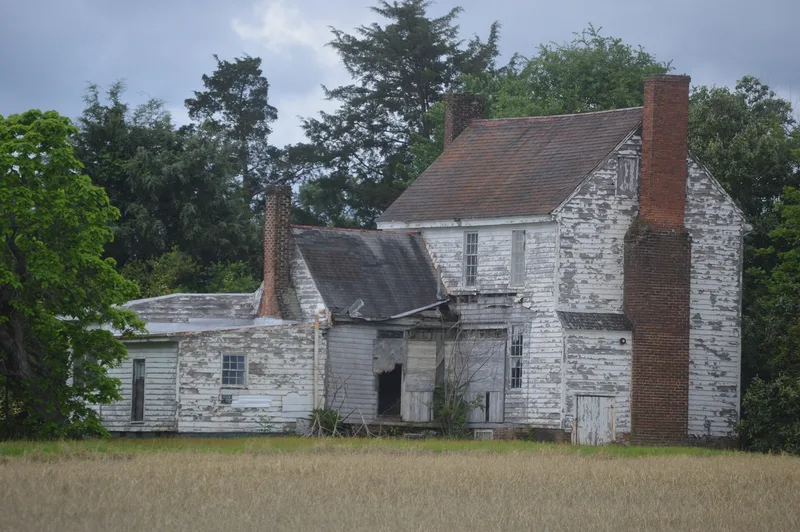
Rose Bower is a farm in rural Dinwiddie County, Virginia, that has been worked by one family since about 1818. The complex includes a small braced-frame kitchen dependency that was the first dwelling, a two-story frame hall-parlor house of 1826 built by Thomas Rose, a smokehouse, a well cover, a stable, a corncrib, an early twentieth-century barn and a roadside country store across the road. A family cemetery lies behind the house. The house mixes Federal features, such as tall chimneys and a low gabled roof, with Colonial ones, including its hall-parlor plan and paneled wainscot. Inside, the grained and marbleized wainscot is a notable feature. The surrounding fields and woods remain largely unchanged, though the farm has shrunk from its earlier acreage. The property was recognized as a locally significant example of an early nineteenth-century plantation, for its continuous agricultural use and for its well-preserved, sophisticated vernacular architecture.
Significance in brief: The nomination argues that Rose Bower is locally significant under Criterion A as a farm worked continuously by the Rose family since the early nineteenth century, still growing many of the same crops. Under Criterion C, it argues that the house combines Colonial and Federal period features and shows skilled regional craftsmanship with a high degree of integrity.
Machine-generated summary. This summary was generated by a language model from the official nomination document and has not been reviewed line by line by an editor. It may contain errors. Check the source document before relying on any detail. Source: nomination document (PDF) · National Archives catalog entry. NRHP reference 91000020, listed February 5, 1991. Summary generated October 2026 (model claude-sonnet-5-5, prompt v1.0-2026-10-29, confidence high).
Key facts
| Address | VA 665 S of jct. with VA 40, Stoney Creek |
|---|---|
| County | Dinwiddie County |
| Listed | February 5, 1991 |
| Reference number | 91000020 |
| Resource type | Building |
| Period of significance | 1818-1940 |
| Architect / builder | Thomas Rose (builder); architect unknown |
| Architectural style | Early Republic: Federal |
| Criteria |
|
| Areas of significance | Agriculture, Architecture |
| Level of significance | Local |
| Status (as stated in the nomination) | The farm is still cultivated by the Rose family (tobacco, corn, soybeans and peanuts). The house is described as in pristine, largely unaltered condition, and the barn and tobacco-processing house are used for equipment storage. The stable is in partial ruin. |
| Acreage | 231 |
| Coordinates | 36.93627, -77.54023 (NPS GIS) |
What listing means for this property
National Register listing is honorary: it recognises significance and does not restrict what a private owner may do without federal money or permits. It unlocks the 20% federal rehabilitation tax credit for income-producing buildings, state credits in many states, and Section 106 review when federal agencies are involved. See what listing means in practice.
General information, not legal or tax advice. Rules change; confirm with your State Historic Preservation Office or a qualified adviser.
Sources and further reading
- National Park Service, National Register of Historic Places database (snapshot May 2026), reference 91000020.
- Nomination form (PDF, National Archives) — catalog entry
- Wikipedia article (used for cross-checking only; text not reproduced here)
- Wikidata Q14713154
- This listing as JSON
Last updated October 2026. Found an error? See the editorial policy for how to report it.