Salubria

Why it's listed
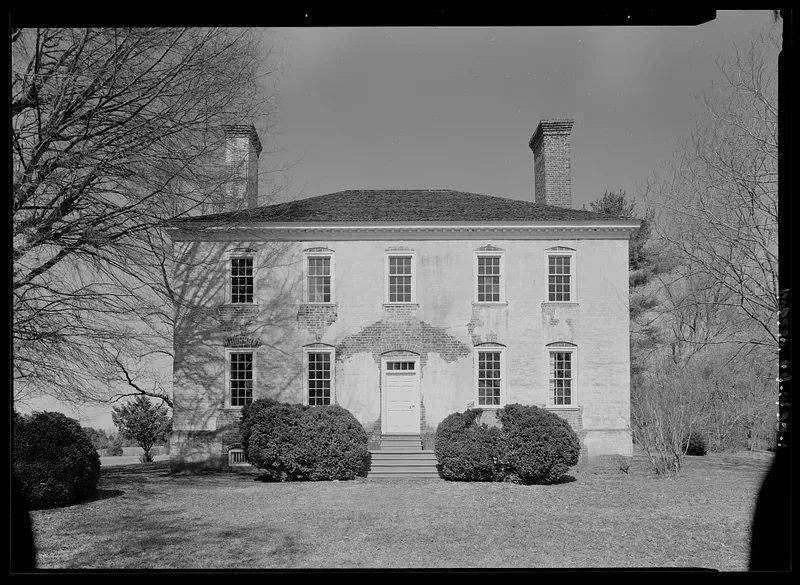
Salubria is a brick mansion near Stevensburg in Culpeper County, Virginia, built in the second quarter of the eighteenth century. Tradition holds that it was constructed in 1742 by John Thompson, Anglican minister to Saint Mark's Parish, around the time of his marriage to the widow of Governor Alexander Spotswood. The house has two stories, a hipped roof, and two large corbel-capped interior-end chimneys. Its Flemish bond brickwork includes segmental arches over the windows and basement openings and a beveled watertable. Inside, the off-center central hall has a high paneled dado and a curving stair, and the rooms have corner fireplaces, including a fully paneled northeast room with a Doric entablature. Lafayette was entertained at dinner here in 1825, and Dr. Cary T. Grayson, physician to President Woodrow Wilson, was born at the house. It was listed for the quality of its compact, refined design and its fine interior woodwork.
Significance in brief: The nomination argues that Salubria is an exceedingly simple yet surprisingly elegant building. Its quality comes from excellent proportions, the rhythm of segmental arches, fine interior paneling and an unusual stair. It also has historical associations with Lafayette's 1825 visit and with Dr. Cary T. Grayson, who was born there.
Machine-generated summary. This summary was generated by a language model from the official nomination document and has not been reviewed line by line by an editor. It may contain errors. Check the source document before relying on any detail. Source: nomination document (PDF) · National Archives catalog entry. NRHP reference 70000789, listed February 16, 1970. Summary generated October 2026 (model claude-sonnet-5-5, prompt v1.0-2026-10-29, confidence medium).
Key facts
| Address | E of jct. of Rtes. 3 and 663, Stevensburg |
|---|---|
| County | Culpeper County |
| Listed | February 16, 1970 |
| Reference number | 70000789 |
| Resource type | Building |
| Period of significance | 18th Century |
| Architect / builder | John Thompson, Anglican minister to Saint Mark's Parish (builder, according to the form) |
| Areas of significance | Architecture, Social History |
| Level of significance | State |
| Status (as stated in the nomination) | Condition listed as good; the form marks preservation work in progress and restoration under way, and the property is a private residence. |
| Acreage | 200 |
| Coordinates | 38.43932, -77.88488 (NPS GIS) |
What listing means for this property
National Register listing is honorary: it recognises significance and does not restrict what a private owner may do without federal money or permits. It unlocks the 20% federal rehabilitation tax credit for income-producing buildings, state credits in many states, and Section 106 review when federal agencies are involved. See what listing means in practice.
General information, not legal or tax advice. Rules change; confirm with your State Historic Preservation Office or a qualified adviser.
Sources and further reading
- National Park Service, National Register of Historic Places database (snapshot May 2026), reference 70000789.
- Nomination form (PDF, National Archives) — catalog entry
- Wikipedia article (used for cross-checking only; text not reproduced here)
- Wikidata Q14713173
- This listing as JSON
Last updated October 2026. Found an error? See the editorial policy for how to report it.