Little Fork Church
Also known as: Oak Shade Church

Why it's listed
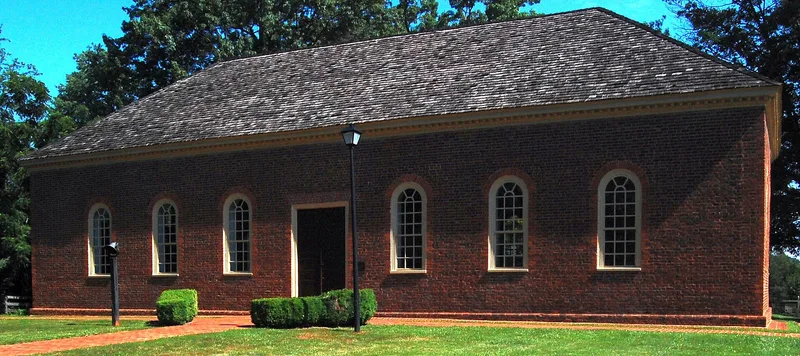
Little Fork Church is a one-story brick chapel in rural Culpeper County, Virginia, raised between 1774 and 1776 after fire destroyed an earlier wooden building in 1773. It measures roughly 83 by 33 feet, with Flemish bond walls, rubbed brick corners and window arches, seven bays on the south wall with six arched windows, a modillion cornice and a hipped roof. Inside, the original reredos between the two east windows has four tablets, Doric pilasters and a triangular pediment. The church is believed to be the work of John Ariss, who is also credited with the nearly identical Lamb's Creek Church. It is one of few colonial churches left in northern Piedmont Virginia, and it served as a chapel of St. Mark's Parish rather than a parish church. Union troops stabled horses there during the Civil War, and Methodists later used it. The surroundings keep the rural character they had in the eighteenth century.
Significance in brief: It is one of the few colonial churches to survive in northern Piedmont Virginia and retains a large share of its original interior, including an elaborate reredos. It is attributed to John Ariss, who is also credited with the nearly identical Lamb's Creek Church. It served as a chapel for St. Mark's Parish.
Machine-generated summary. This summary was generated by a language model from the official nomination document and has not been reviewed line by line by an editor. It may contain errors. Check the source document before relying on any detail. Source: nomination document (PDF) · National Archives catalog entry. NRHP reference 69000234, listed November 12, 1969. Summary generated October 2026 (model claude-sonnet-5-5, prompt v1.0-2026-10-29, confidence medium).
Key facts
| Address | Jct. of Rtes. 624 and 726, Rixeyville |
|---|---|
| County | Culpeper County |
| Listed | November 12, 1969 |
| Reference number | 69000234 |
| Resource type | Building |
| Period of significance | 1774-76 |
| Architect / builder | John Ariss (believed designer) |
| Architectural style | Colonial |
| Areas of significance | Architecture |
| Level of significance | State |
| Status (as stated in the nomination) | Condition listed as fair and altered; described as relatively neglected in 1969 and again serving as a chapel for St. Mark's Parish. A later grant application says it was being restored. |
| Acreage | 1 |
| Coordinates | 38.59999, -77.95465 (NPS GIS) |
What listing means for this property
Religious properties are listed for their architectural or historical significance, not their religious use. Listing is honorary and does not restrict the congregation's use of the building. The federal rehabilitation credit is generally unavailable unless part of the building is income-producing; some state programmes and preservation grants do cover religious buildings. Federal funding or permits trigger Section 106 review.
General information, not legal or tax advice. Rules change; confirm with your State Historic Preservation Office or a qualified adviser.
Sources and further reading
- National Park Service, National Register of Historic Places database (snapshot May 2026), reference 69000234.
- Nomination form (PDF, National Archives) — catalog entry
- Wikipedia article (used for cross-checking only; text not reproduced here)
- Wikidata Q6650077
- This listing as JSON
Last updated October 2026. Found an error? See the editorial policy for how to report it.