Bowling Green Historic District
Also known as: 171-5001

Why it's listed
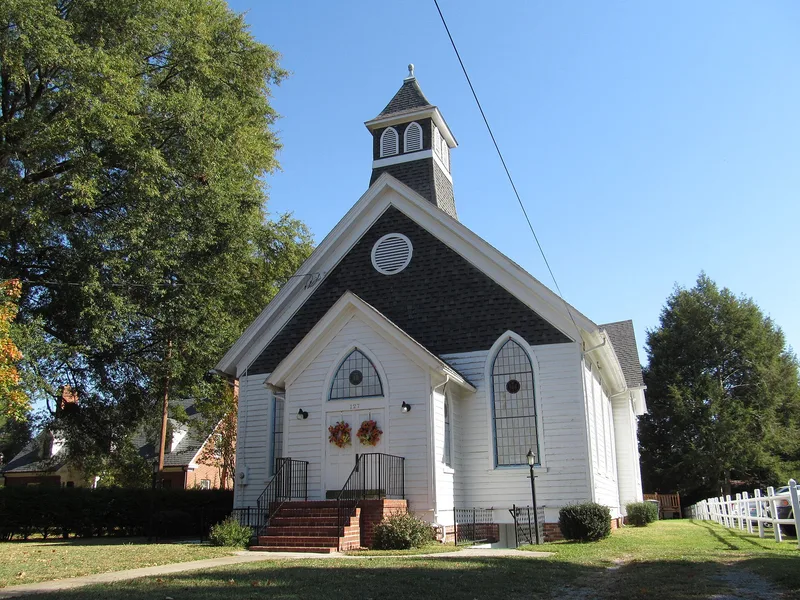
Bowling Green is a compact county-seat town in Caroline County, Virginia, about forty miles north of Richmond, where U.S. Route 301 meets State Route 207. Its historic district holds 224 primary resources and 148 secondary ones, including a colonial plantation house known as Old Mansion and the brick Caroline County Courthouse, which reflects Thomas Jefferson's pavilion designs and may have been built by craftsmen who worked for him. Most churches are Gothic Revival, while the houses range from Greek Revival to Queen Anne, Colonial Revival and bungalows. Fires in 1900 and 1955 destroyed much of the commercial downtown, so few business buildings predate the mid-twentieth century. The district was recognized for its role as a seat of government and regional crossroads and for the architecture preserved by slow, stable growth. Its period of significance runs from about 1750 to 1952.
Significance in brief: The district is significant for architecture, commerce, politics/government and transportation. It has served for two centuries as the county seat and a regional crossroads, and slow development has preserved its nineteenth-century churches and houses. Its centerpiece is the Jeffersonian-influenced Caroline County Courthouse.
Machine-generated summary. This summary was generated by a language model from the official nomination document and has not been reviewed line by line by an editor. It may contain errors. Check the source document before relying on any detail. Source: nomination document (PDF) · National Archives catalog entry. NRHP reference 03000439, listed May 22, 2003. Summary generated October 2026 (model claude-sonnet-5-5, prompt v1.0-2026-10-29, confidence medium).
Key facts
| Address | Roughly along and bounded by Bowling Green Bypass, Broadus Ave., Lakewood Rd., N. Main St., and Paige Rd., Bowling Green |
|---|---|
| County | Caroline County |
| Listed | May 22, 2003 |
| Reference number | 03000439 |
| Resource type | District |
| Period of significance | ca. 1750-1952 |
| Architect / builder | David Jeptha Rose; William P. Rose; Bartholomew F. Smith; William Callis West; John J. Ballentine; Courthouse attributed to William B. Phillips and Malcolm Crawford (Jefferson workmen) |
| Architectural style | Colonial, Early Republic, Greek Revival, Gothic Revival, Italianate, Queen Anne, Beaux Arts, Colonial Revival, Bungalow/Craftsman and other styles |
| Criteria |
|
| Areas of significance | Architecture, Commerce, Politics/Government, Transportation |
| Level of significance | Local |
| Status (as stated in the nomination) | Still a working town center with homes, businesses, churches and county government offices; the 1912 bank building is now used for retail and the old jail is a museum. |
| Acreage | 297 |
| Coordinates | 38.04890, -77.34961 (NPS GIS) |
What listing means for this property
This is a historic district. Buildings within its boundary are either contributing (they add to the district's significance) or non-contributing. Owners of contributing income-producing buildings can claim the 20% federal rehabilitation tax credit; homeowners should look at state credits. National Register districts impose no design review by themselves; a local historic district ordinance, if one exists, does (the difference explained).
General information, not legal or tax advice. Rules change; confirm with your State Historic Preservation Office or a qualified adviser.
Sources and further reading
- National Park Service, National Register of Historic Places database (snapshot May 2026), reference 03000439.
- Nomination form (PDF, National Archives) — catalog entry
- Wikipedia article (used for cross-checking only; text not reproduced here)
- Wikidata Q14712055
- This listing as JSON
Last updated October 2026. Found an error? See the editorial policy for how to report it.