Buckingham Female Collegiate Institute Historic District
Also known as: VHLC File No.14-127
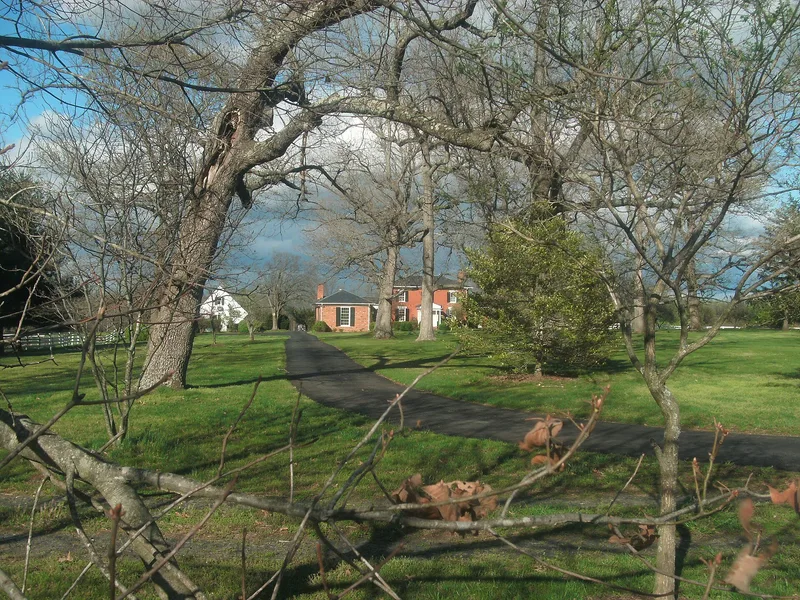

Why it's listed
Along VA Route 617 at Gravel Hill in Buckingham County stand the surviving buildings of a community built around Virginia's first chartered women's college. The Buckingham Female Collegiate Institute was incorporated in 1837, welcomed students in 1838, and operated intermittently until 1863. Its main building was dismantled in 1906, but five related structures remain: the brick President's House of about 1852-53, the Henry James Brown House, a tavern and store-dwelling associated with John S. West, and a house built for an Institute instructor. Methodist leaders backed the school and offered a college curriculum with degrees, unlike most female schools of the era. Faculty included the Rev. John Chapman Blackwell and the minister and painter Henry James Brown. Together the buildings preserve the look of an antebellum rural crossroads and recall an early chapter in women's education in Virginia. A 1980 chapel on the site is too recent to contribute.
Significance in brief: The district is argued to represent the first chartered college for women in Virginia and the antebellum movement for women's higher education, supported by Virginia Methodists. Five surviving buildings, including the President's House and faculty residences, preserve the image of an antebellum crossroads community that depended on the school. The main Institute building was dismantled in 1906.
Machine-generated summary. This summary was generated by a language model from the official nomination document and has not been reviewed line by line by an editor. It may contain errors. Check the source document before relying on any detail. Source: nomination document (PDF) · National Archives catalog entry. NRHP reference 84000035, listed October 4, 1984. Summary generated October 2026 (model claude-sonnet-5-5, prompt v1.0-2026-10-29, confidence medium).
Key facts
| Address | VA 617, Gravel Hill |
|---|---|
| County | Buckingham County |
| Listed | October 4, 1984 |
| Reference number | 84000035 |
| Resource type | District |
| Period of significance | 1837-1863 |
| Architect / builder | Carrol M. Shepard and others |
| Architectural style | Greek Revival (President's House and Henry James Brown House); also Colonial Revival alterations |
| Areas of significance | Education, Religion, Social History |
| Level of significance | State |
| Status (as stated in the nomination) | Five of the six properties contribute; Brown's Chapel (1980) does not. The Cobb-West-England-Dennis House is described as abandoned or unoccupied, while the other buildings are in residential use. |
| Acreage | 18 |
| Coordinates | 37.58299, -78.37333 (NPS GIS) |
What listing means for this property
This is a historic district. Buildings within its boundary are either contributing (they add to the district's significance) or non-contributing. Owners of contributing income-producing buildings can claim the 20% federal rehabilitation tax credit; homeowners should look at state credits. National Register districts impose no design review by themselves; a local historic district ordinance, if one exists, does (the difference explained).
General information, not legal or tax advice. Rules change; confirm with your State Historic Preservation Office or a qualified adviser.
Sources and further reading
- National Park Service, National Register of Historic Places database (snapshot May 2026), reference 84000035.
- Nomination form (PDF, National Archives) — catalog entry
- Wikipedia article (used for cross-checking only; text not reproduced here)
- Wikidata Q14712101
- This listing as JSON
Last updated October 2026. Found an error? See the editorial policy for how to report it.