Old Stone House
Also known as: Robert Sitlington House

Why it's listed
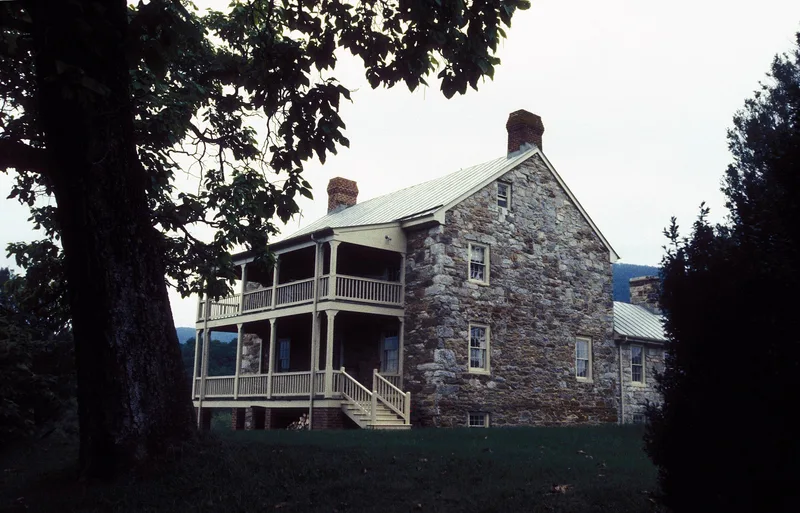
Set on a hill above a bend in the Cowpasture River in southeastern Bath County, this two-story stone farmhouse is locally called the "old stone house." Believed to date from the 1790s, it was built by Robert Sitlington, a Revolutionary War militia veteran, county justice and wealthy landowner who helped organize Bath County in 1790. The walls are coursed fieldstone laid in clay-and-hair mortar, and the stone is said to be foreign to the area, likely hauled over the Allegheny Mountains. The three-room plan with central passage and corner fireplaces resembles farmhouses of the Shenandoah Valley rather than the local frontier. It is believed to be the county's oldest stone dwelling. Later changes include a late-nineteenth-century double gallery, replacement windows and brick chimneys, and a 1920s interior remodeling by Robert V. Porter that gave the rooms a bungalow character. The house retains its basic exterior form and original plan, and it is currently vacant pending restoration.
Significance in brief: It is believed to be the oldest stone house in Bath County, an area with few stone buildings. Its stone construction and three-room plan with central passage reflect Germanic-influenced farmhouse traditions of the Shenandoah Valley, carried across the Allegheny Mountains by builder Robert Sitlington, a prominent local citizen who helped organize the county in 1790.
Machine-generated summary. This summary was generated by a language model from the official nomination document and has not been reviewed line by line by an editor. It may contain errors. Check the source document before relying on any detail. Source: nomination document (PDF) · National Archives catalog entry. NRHP reference 83003262, listed February 10, 1983. Summary generated October 2026 (model claude-sonnet-5-5, prompt v1.0-2026-10-29, confidence high).
Key facts
| Address | SW of Milboro Springs on VA 664, Millboro Springs |
|---|---|
| County | Bath County |
| Listed | February 10, 1983 |
| Reference number | 83003262 |
| Resource type | Building |
| Period of significance | 1790s |
| Architect / builder | Robert Sitlington (builder, per the historical narrative); form lists Builder/Architect as N/A |
| Architectural style | Germanic-influenced Shenandoah Valley farmhouse tradition; 1920s bungalow-style interior woodwork |
| Areas of significance | Architecture |
| Level of significance | State |
| Status (as stated in the nomination) | Described as in a good state of preservation and presently vacant, with restoration plans to preserve the exterior and interior with few modifications. |
| Acreage | 125 |
| Coordinates | 37.92628, -79.73118 (NPS GIS) |
What listing means for this property
National Register listing is honorary for a privately owned home: it does not by itself restrict what an owner may do with their own money, and it does not require public access. Restrictions come from local landmark or historic-district ordinances, which are separate (how they differ).
Owner-occupied houses are not eligible for the 20% federal rehabilitation tax credit, which applies to income-producing buildings, but many states offer credits for homeowners. Listing also opens the door to preservation easements and to buying a plaque. Start with what listing means for homeowners, renovating a listed house and selling one.
Noted as vacant in the nomination. Nomination documents can be decades old; current status may differ. If you are considering buying an empty listed property, read the due-diligence checklist.
General information, not legal or tax advice. Rules change; confirm with your State Historic Preservation Office or a qualified adviser.
Sources and further reading
- National Park Service, National Register of Historic Places database (snapshot May 2026), reference 83003262.
- Nomination form (PDF, National Archives) — catalog entry
- Wikipedia article (used for cross-checking only; text not reproduced here)
- Wikidata Q14713023
- This listing as JSON
Last updated October 2026. Found an error? See the editorial policy for how to report it.