Geddes

Why it's listed
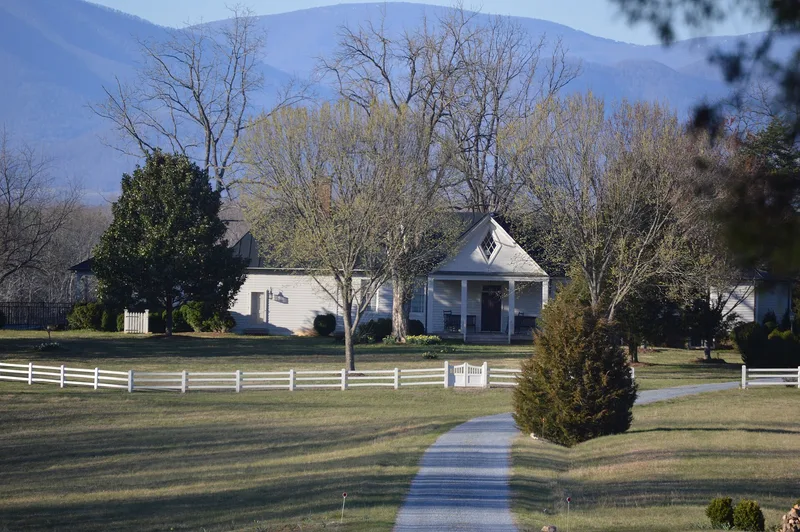
Geddes is a long, 1½-story frame farmhouse set in a shallow valley of open fields near Clifford, Amherst County, with views toward the Blue Ridge. Local residents long called it the county's oldest house. The earliest two rooms date to about 1762 and were built for Hugh Rose, son of the Anglican clergyman and diarist Robert Rose. Around 1800 a center hall and west rooms were added, creating the present center-hall plan, and mid-19th-century porches and a rear ell followed. Inside are Federal mantels, built-in press cupboards, early feather graining and a steep open-string stair. Hugh Rose served as a militia colonel and represented Amherst County in the General Assembly. He is remembered as a friend of Thomas Jefferson, whose family stayed at Geddes during the 1781 British raid on Charlottesville. Descendants of the Rose and Claiborne families have owned the property since, and the house survives as one of the county's few Colonial-era buildings.
Significance in brief: The nomination argues Geddes is a vernacular late-Colonial frame house that has survived virtually intact since its early 19th-century enlargement. It was built for Hugh Rose, a militia colonel and Assembly member who sheltered Thomas Jefferson's family in 1781. It is also one of Amherst County's few surviving Colonial-period buildings.
Machine-generated summary. This summary was generated by a language model from the official nomination document and has not been reviewed line by line by an editor. It may contain errors. Check the source document before relying on any detail. Source: nomination document (PDF) · National Archives catalog entry. NRHP reference 83003257, listed February 24, 1983. Summary generated October 2026 (model claude-sonnet-5-5, prompt v1.0-2026-10-29, confidence high).
Key facts
| Address | SR 700, Clifford |
|---|---|
| County | Amherst County |
| Listed | February 24, 1983 |
| Reference number | 83003257 |
| Resource type | Building |
| Period of significance | Late 18th - Mid-19th Century |
| Architect / builder | Hugh Rose |
| Architectural style | Vernacular late-Colonial frame building with Federal interior detailing |
| Areas of significance | Exploration/Settlement, Architecture |
| Level of significance | State |
| Status (as stated in the nomination) | Occupied private residence in fair condition, unaltered and on its original site; only a springhouse survives of the former outbuildings. |
| Acreage | 13 |
| Coordinates | 37.66614, -78.98725 (NPS GIS) |
What listing means for this property
National Register listing is honorary: it recognises significance and does not restrict what a private owner may do without federal money or permits. It unlocks the 20% federal rehabilitation tax credit for income-producing buildings, state credits in many states, and Section 106 review when federal agencies are involved. See what listing means in practice.
General information, not legal or tax advice. Rules change; confirm with your State Historic Preservation Office or a qualified adviser.
Sources and further reading
- National Park Service, National Register of Historic Places database (snapshot May 2026), reference 83003257.
- Nomination form (PDF, National Archives) — catalog entry
- Wikipedia article (used for cross-checking only; text not reproduced here)
- Wikidata Q14712351
- This listing as JSON
Last updated October 2026. Found an error? See the editorial policy for how to report it.