Odd Fellows Hall
Also known as: Dhr#100-5015-0005

Why it's listed
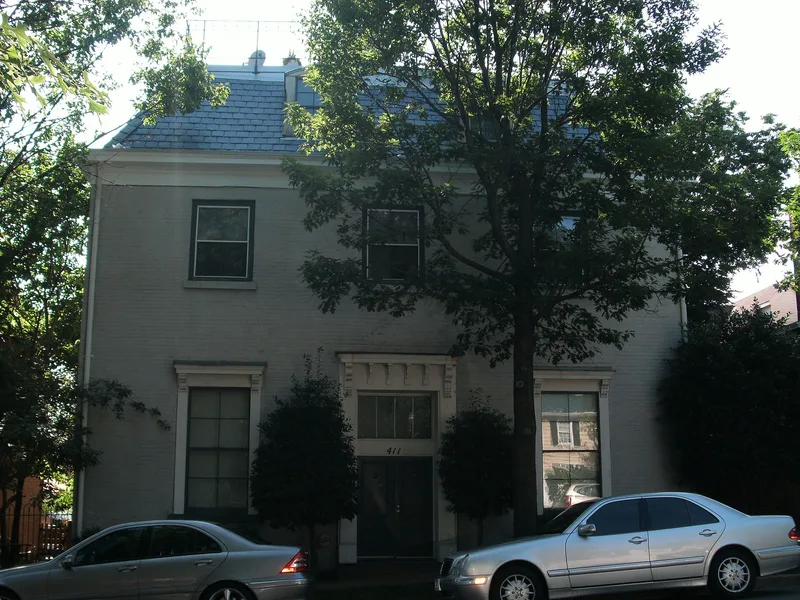
Odd Fellows Hall, at 411 South Columbus Street in Alexandria, Virginia, is a two-and-a-half-story brick building in the Bottoms, one of the city's oldest African American neighborhoods. It began as a one-story brick building in 1864, possibly built for an African Methodist Episcopal church. In 1869 James Webster, Robert Darnell and John Credit formed the Odd Fellows Joint Stock Company and bought it. Local master carpenter George Seaton enlarged it in 1870 with Freedmen's Bureau funding, adding a slate mansard roof and Second Empire detailing. For more than a century it served as a meeting place for fraternal and benevolent societies founded by and for African Americans, and it hosted festivals and receptions. Few non-religious buildings in the city could hold large, racially unrestricted gatherings. Meetings ended in 1974, and the building was converted to five condominiums in 1984-85. The interior was heavily altered, but the facade keeps its original character, and the hall remains important to local African American history.
Significance in brief: It is one of the only surviving structures from 1790 to 1953 associated with African American communal organizations in Alexandria. It hosted secret societies, benevolent groups, festivals and social events, and it was one of few non-religious buildings that could hold large groups regardless of race. Funding for the 1870 enlargement came from the Freedmen's Bureau.
Machine-generated summary. This summary was generated by a language model from the official nomination document and has not been reviewed line by line by an editor. It may contain errors. Check the source document before relying on any detail. Source: nomination document (PDF) · National Archives catalog entry. NRHP reference 03001427, listed January 16, 2004. Summary generated October 2026 (model claude-sonnet-5-5, prompt v1.0-2026-10-29, confidence high).
Key facts
| Address | 411 S. Columbus St., Alexandria (Independent City) |
|---|---|
| County | Alexandria |
| Listed | January 16, 2004 |
| Reference number | 03001427 |
| Resource type | Building |
| Period of significance | 1869-1953 |
| Architect / builder | George L. Seaton |
| Architectural style | Second Empire |
| Criteria |
|
| Areas of significance | Black |
| Level of significance | Local |
| Status (as stated in the nomination) | Rehabilitated in 1984-85 and converted into five residential condominium units after standing vacant for several years; meetings ended in 1974. |
| Acreage | 0.9 |
| Within district | Alexandria Historic District |
| Coordinates | 38.80327, -77.04893 (NPS GIS) |
What listing means for this property
National Register listing is honorary for a privately owned home: it does not by itself restrict what an owner may do with their own money, and it does not require public access. Restrictions come from local landmark or historic-district ordinances, which are separate (how they differ).
Owner-occupied houses are not eligible for the 20% federal rehabilitation tax credit, which applies to income-producing buildings, but many states offer credits for homeowners. Listing also opens the door to preservation easements and to buying a plaque. Start with what listing means for homeowners, renovating a listed house and selling one.
General information, not legal or tax advice. Rules change; confirm with your State Historic Preservation Office or a qualified adviser.
Sources and further reading
- National Park Service, National Register of Historic Places database (snapshot May 2026), reference 03001427.
- Nomination form (PDF, National Archives) — catalog entry
- Wikipedia article (used for cross-checking only; text not reproduced here)
- Wikidata Q7077345
- This listing as JSON
Last updated October 2026. Found an error? See the editorial policy for how to report it.