Texas Tourist Camp
Also known as: Texas Tourist Courts; Texas Cafe; Texaco Petrified Wood Statio

Why it's listed
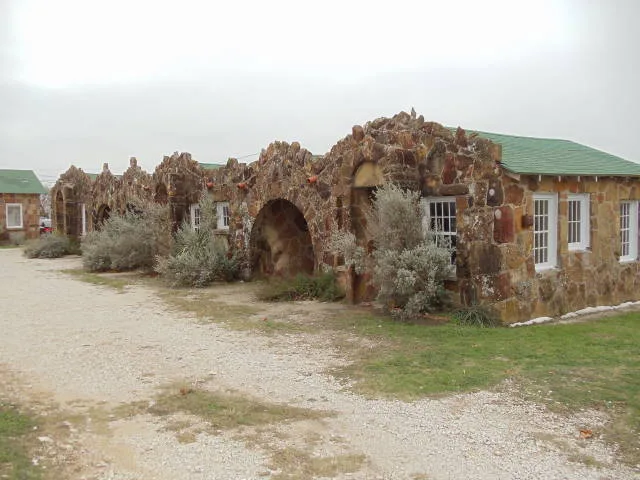
Five buildings along the old Meridian Highway in Decatur, Texas, make up a tourist camp that grew from a roadside campground into a full service stop for motorists. Local businessman E.F. Boydston bought the land in 1927 and built a shed and a Texaco station. A cafe followed in 1929, cabins with garages in 1931, and an office/residence and two more cabins in 1935. His son Nolan faced the station with petrified wood gathered from nearby towns, and other buildings received sandstone and assorted rock veneers, arched porches and neon signs. The station operated until 1988, while the cafe closed in the early 1960s after a highway bypass drew traffic away from the site. The complex is considered significant locally as an early example of a commercial roadside type and for its use of found materials in roadside architecture. Its period of significance runs from 1927 to 1953, and several buildings are again in use.
Significance in brief: The complex is argued to be an early local example of a tourist court serving automobile travelers, significant in Commerce under Criterion A. Its veneers of sandstone, assorted rock and petrified wood are cited as reflecting early 20th century roadside architecture trends under Criterion C. Significance is local.
Machine-generated summary. This summary was generated by a language model from the official nomination document and has not been reviewed line by line by an editor. It may contain errors. Check the source document before relying on any detail. Source: nomination document (PDF) · National Archives catalog entry. NRHP reference 97000477, listed May 30, 1997. Summary generated October 2026 (model claude-sonnet-5-5, prompt v1.0-2026-10-29, confidence high).
Key facts
| Address | 900--904 S US 81/287, Decatur |
|---|---|
| County | Wise County |
| Listed | May 30, 1997 |
| Reference number | 97000477 |
| Resource type | Building |
| Period of significance | 1927 - 1953 |
| Architect / builder | Boydston, E.F.; Boydston, Nolan |
| Architectural style | OTHER: L-plan tourist court |
| Criteria |
|
| Areas of significance | Architecture, Commerce |
| Level of significance | Local |
| Status (as stated in the nomination) | Restored as close as economically feasible to its 1953 appearance. The cafe reopened in 1993, the office/residence serves as an insurance office, and the station has been rehabilitated as an office; in 1995 the camp was remodeled for use as a cafe and office complex. |
| Acreage | 2.5 |
| Coordinates | 33.22852, -97.57619 (NPS GIS) |
What listing means for this property
National Register listing is honorary: it recognises significance and does not restrict what a private owner may do without federal money or permits. It unlocks the 20% federal rehabilitation tax credit for income-producing buildings, state credits in many states, and Section 106 review when federal agencies are involved. See what listing means in practice.
General information, not legal or tax advice. Rules change; confirm with your State Historic Preservation Office or a qualified adviser.
Sources and further reading
- National Park Service, National Register of Historic Places database (snapshot May 2026), reference 97000477.
- Nomination form (PDF, National Archives) — catalog entry
- Wikipedia article (used for cross-checking only; text not reproduced here)
- Wikidata Q110000111
- This listing as JSON
Last updated October 2026. Found an error? See the editorial policy for how to report it.