Dewberry, Col. John, House

Why it's listed
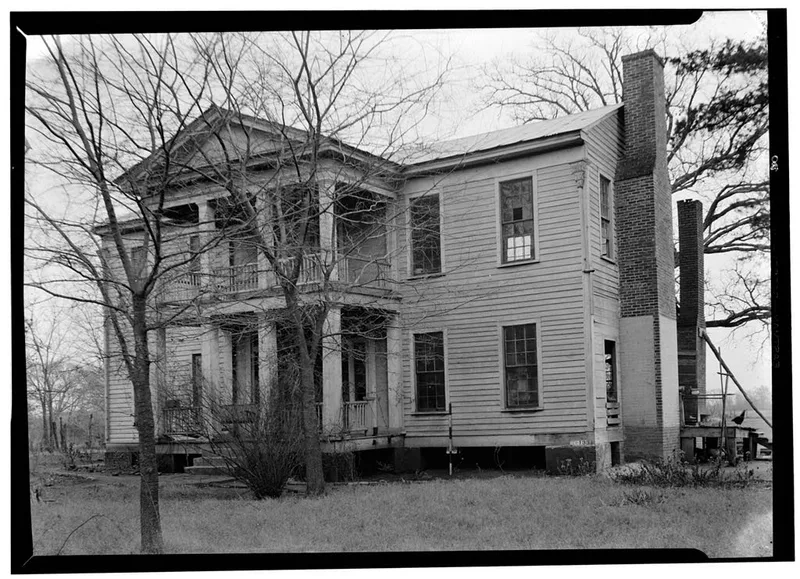
Built in 1854 on a farm near Teasleville in Smith County, Texas, this two-story frame house is a representative example of Greek Revival design from the years before the Civil War. It was erected by Colonel John Dewberry, a Georgia native who came to Texas in the late 1830s, settled in Smith County about 1840 and bought 20,000 acres of plantation land in the Saline Prairie area. The house rests on brick piers, has end chimneys and a low-pitched gable roof, and presents a double pedimented gallery with square wooden columns on its west front. Nine-over-nine windows and flush siding inside the gallery are typical of Texas Greek Revival work. The wide central hall opens through broad paneled doors with sidelights and a transom, allowing summer breezes to pass through the house. The nomination describes the house as unaltered, and it was recorded as a Texas Historic Landmark in 1962.
Significance in brief: The nomination presents it as an unaltered example of the roomy Greek Revival domestic architecture found in Texas in the decades before the Civil War. It was built by Colonel John Dewberry, a prosperous planter and Confederate officer who settled in Smith County around 1840. The wide central hall and broad entrance doors that open to catch the breeze are noted as characteristic features.
Machine-generated summary. This summary was generated by a language model from the official nomination document and has not been reviewed line by line by an editor. It may contain errors. Check the source document before relying on any detail. Source: nomination document (PDF) · National Archives catalog entry. NRHP reference 71000963, listed May 6, 1971. Summary generated October 2026 (model claude-sonnet-5-5, prompt v1.0-2026-10-29, confidence high).
Key facts
| Address | 1 mi. N of Teaselville on FM 346, Teaselville |
|---|---|
| County | Smith County |
| Listed | May 6, 1971 |
| Reference number | 71000963 |
| Resource type | Building |
| Period of significance | 1854 |
| Architectural style | Greek Revival |
| Areas of significance | Architecture |
| Level of significance | State |
| Status (as stated in the nomination) | Listed in good condition, unaltered, on its original site, and occupied as a private residence. |
| Acreage | 3 |
| Coordinates | 32.15692, -95.40617 (NPS GIS) |
What listing means for this property
National Register listing is honorary for a privately owned home: it does not by itself restrict what an owner may do with their own money, and it does not require public access. Restrictions come from local landmark or historic-district ordinances, which are separate (how they differ).
Owner-occupied houses are not eligible for the 20% federal rehabilitation tax credit, which applies to income-producing buildings, but many states offer credits for homeowners. Listing also opens the door to preservation easements and to buying a plaque. Start with what listing means for homeowners, renovating a listed house and selling one.
General information, not legal or tax advice. Rules change; confirm with your State Historic Preservation Office or a qualified adviser.
Sources and further reading
- National Park Service, National Register of Historic Places database (snapshot May 2026), reference 71000963.
- Nomination form (PDF, National Archives) — catalog entry
- Wikidata Q110001312
- This listing as JSON
Last updated October 2026. Found an error? See the editorial policy for how to report it.