Fort Stockton Historic District

The pin is a point inside the NPS boundary polygon, not a surveyed location.
Why it's listed
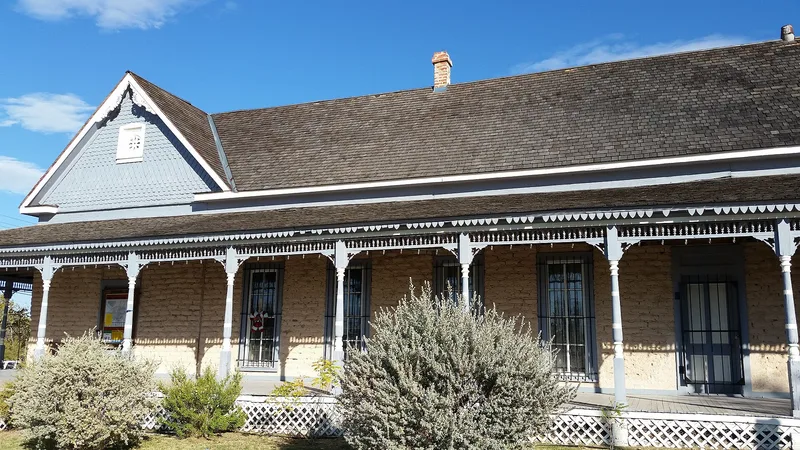
Fort Stockton's historic district gathers the surviving pieces of an Army post and the frontier town that grew beside it at Comanche Springs, the third largest springs in Texas. The fort was first established in 1858, abandoned to Confederate forces, and rebuilt from 1868 until the Army left in 1886. What remains includes three adobe officers' quarters, a limestone guardhouse dated 1868, stone barracks foundations and the old fort cemetery. Town buildings include the Koehler store, the Grey Mule Saloon, the John Young store, St. Stephen's Episcopal Church of 1896, and the Annie Riggs Hotel of 1900, now a museum. The district was recognised because fort and town survive side by side, showing how a frontier settlement developed at a military outpost. A later amendment added the Achterberg House, an adobe house begun in 1901 and enlarged over several decades, as a contributing building.
Significance in brief: The nomination argues the district is an excellent example of a frontier settlement that grew up beside a military outpost, with surviving parts of both fort and town. It reflects the frontier history of the trans-Pecos region, including the fort's role protecting the San Antonio-San Diego stage line and its brief link to the Army camel experiment.
Machine-generated summary. This summary was generated by a language model from the official nomination document and has not been reviewed line by line by an editor. It may contain errors. Check the source document before relying on any detail. Source: nomination document (PDF) · National Archives catalog entry. NRHP reference 73001971, listed April 2, 1973. Summary generated October 2026 (model claude-sonnet-5-5, prompt v1.0-2026-10-29, confidence medium).
Key facts
| Address | E edge of town, Fort Stockton |
|---|---|
| County | Pecos County |
| Listed | April 2, 1973 |
| Reference number | 73001971 |
| Resource type | District |
| Period of significance | 1858-1886 |
| Architect / builder | Lieut. J. L. Humfreville (guardhouse, 1868); J. Fred Achterberg (Achterberg House) |
| Architectural style | Adobe and stone frontier military and commercial buildings, with Victorian elements; Mexican vernacular for the Achterberg House |
| Areas of significance | Architecture |
| Level of significance | State |
| Status (as stated in the nomination) | Annie Riggs Hotel is now a local museum; the Achterberg House was rehabilitated in 2001 and is in excellent structural condition. |
| Acreage | 75 |
| Coordinates | 30.88779, -102.87613 (NPS GIS) |
What listing means for this property
This is a historic district. Buildings within its boundary are either contributing (they add to the district's significance) or non-contributing. Owners of contributing income-producing buildings can claim the 20% federal rehabilitation tax credit; homeowners should look at state credits. National Register districts impose no design review by themselves; a local historic district ordinance, if one exists, does (the difference explained).
General information, not legal or tax advice. Rules change; confirm with your State Historic Preservation Office or a qualified adviser.
Sources and further reading
- National Park Service, National Register of Historic Places database (snapshot May 2026), reference 73001971.
- Nomination form (PDF, National Archives) — catalog entry
- Wikipedia article (used for cross-checking only; text not reproduced here)
- Wikidata Q54871450
- This listing as JSON
Last updated October 2026. Found an error? See the editorial policy for how to report it.