Barret, Tol, House

Why it's listed
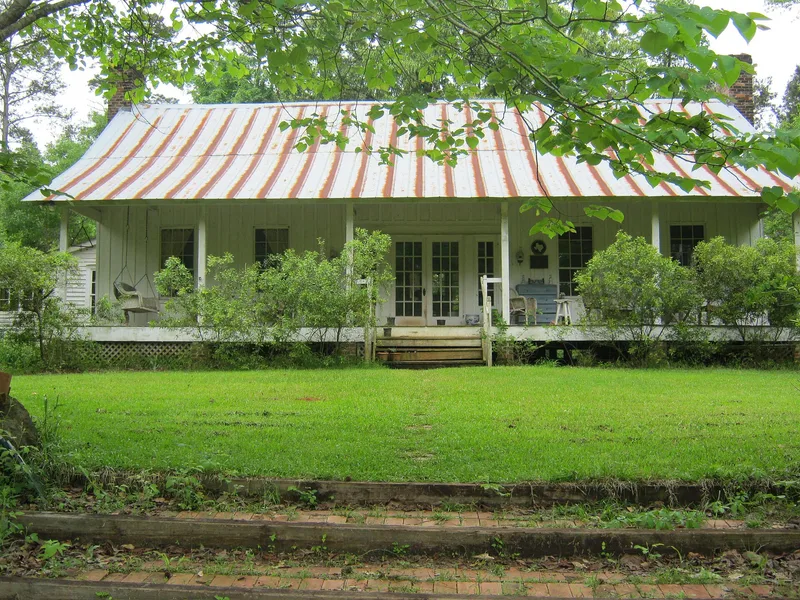
Built around 1848, this one-story frame farmhouse near Nacogdoches was originally a two-room dog-run dwelling made of locally milled pine. John B. Hardeman built it and sold it in 1867 to Tol Barret, who lived there until he died in 1913. Barret was a merchant and Confederate officer who founded the Melrose Petroleum Company and completed Texas' first producing oil well in 1866. The house is the only surviving building tied directly to him. Its symmetrical front has a central door, 12/12 windows and a full-length porch. Vertical 2-by-12-inch pine boards, unusual for the region and period, were exposed when later siding was removed. A rear shed addition came in the late nineteenth century. Neglected after 1956 and slated for demolition in 1975, the house was bought and moved to a rural setting resembling the original. Its owners are restoring it to the Barret period and plan to reconstruct the chimneys.
Significance in brief: It is a good example of a mid-19th century east Texas farmhouse with unusual details, including 12/12 windows and vertical 2" x 12" pine board construction. It was the home of Tol Barret, who completed Texas' first producing oil well, from 1867 until his death in 1913. It is the only surviving building directly associated with him.
Machine-generated summary. This summary was generated by a language model from the official nomination document and has not been reviewed line by line by an editor. It may contain errors. Check the source document before relying on any detail. Source: nomination document (PDF) · National Archives catalog entry. NRHP reference 79002998, listed July 27, 1979. Summary generated October 2026 (model claude-sonnet-5-5, prompt v1.0-2026-10-29, confidence high).
Key facts
| Address | S of Nacogdoches, Nacogdoches |
|---|---|
| County | Nacogdoches County |
| Listed | July 27, 1979 |
| Reference number | 79002998 |
| Resource type | Building |
| Architect / builder | John B. Hardeman (built the original two-room dog-run house about 1848) |
| Architectural style | Mid-nineteenth century east Texas farmhouse (dog-run plan) |
| Areas of significance | Industry, Architecture |
| Level of significance | Local |
| Status (as stated in the nomination) | Moved in 1975 to save it from demolition; being restored to its Barret-era appearance for use as a guest house. The form lists the status as work in progress and unoccupied/vacant. |
| Acreage | 0.9 |
| Coordinates | 31.53596, -94.66712 (NPS GIS) |
What listing means for this property
National Register listing is honorary for a privately owned home: it does not by itself restrict what an owner may do with their own money, and it does not require public access. Restrictions come from local landmark or historic-district ordinances, which are separate (how they differ).
Owner-occupied houses are not eligible for the 20% federal rehabilitation tax credit, which applies to income-producing buildings, but many states offer credits for homeowners. Listing also opens the door to preservation easements and to buying a plaque. Start with what listing means for homeowners, renovating a listed house and selling one.
Noted as vacant in the nomination. Nomination documents can be decades old; current status may differ. If you are considering buying an empty listed property, read the due-diligence checklist.
General information, not legal or tax advice. Rules change; confirm with your State Historic Preservation Office or a qualified adviser.
Sources and further reading
- National Park Service, National Register of Historic Places database (snapshot May 2026), reference 79002998.
- Nomination form (PDF, National Archives) — catalog entry
- Wikidata Q107321775
- This listing as JSON
Last updated October 2026. Found an error? See the editorial policy for how to report it.