Devine Opera House
Also known as: Briscoe Building

Why it's listed
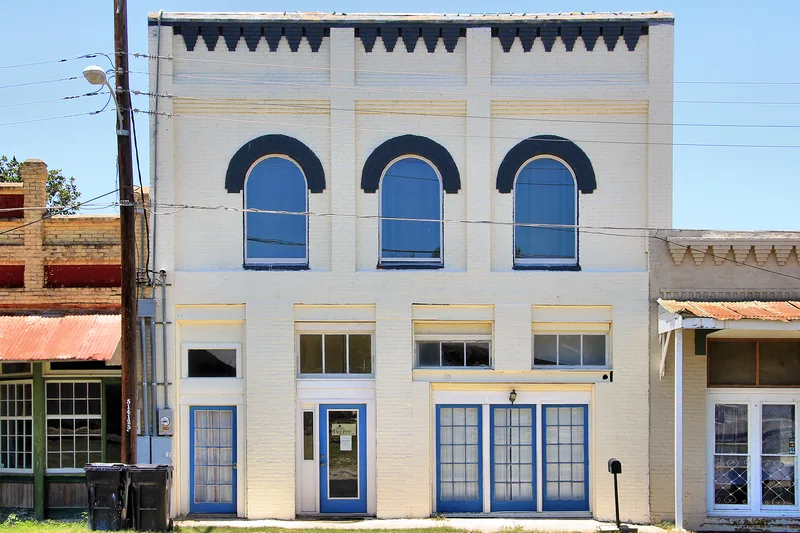
Built in 1906, this two-story brick building on Transportation Boulevard in Devine, Texas, was designed as a mercantile store below and an opera house above. Builder Wiley Moss constructed it for George T. Briscoe, Sr., a prominent citizen with large land holdings and ownership of the Devine Lumber Company. Its simplified Romanesque facade features a corbel table and three round-arched second-floor windows with brick hoodmolds. The railroad depot sat directly across the main street, and the railroad had founded the town in 1883. Traveling shows and musicals booked monthly from San Antonio, along with school plays and presentations, filled the upper floor, which also served as a meeting hall for community activities. Townspeople esteemed it as a sign of cultural progress. At the time of listing the building was deteriorated and used as a feed store, with its canopy removed and some openings altered, though the pine second floor remained restorable.
Significance in brief: It was Devine's first social center, with a theater and meeting hall on the upper floor, located across from the railroad depot that brought people from San Antonio. It was a symbol of cultural progress for the townspeople. It also reflects the town's railroad-founded origins and the role of its original owner, a prominent local landowner and lumber company owner.
Machine-generated summary. This summary was generated by a language model from the official nomination document and has not been reviewed line by line by an editor. It may contain errors. Check the source document before relying on any detail. Source: nomination document (PDF) · National Archives catalog entry. NRHP reference 75001999, listed April 24, 1975. Summary generated October 2026 (model claude-sonnet-5-5, prompt v1.0-2026-10-29, confidence medium).
Key facts
| Address | Transportation Blvd., Devine |
|---|---|
| County | Medina County |
| Listed | April 24, 1975 |
| Reference number | 75001999 |
| Resource type | Building |
| Period of significance | 1906 |
| Architect / builder | Wiley Moss |
| Architectural style | Simplified commercial Romanesque |
| Areas of significance | Performing Arts |
| Level of significance | Local |
| Status (as stated in the nomination) | Deteriorated condition; in use as a feed store at the time of nomination, with a removed canopy, altered first-floor openings, and corrugated tin and plywood replacing much of the window and door glass. |
| Acreage | 0.9 |
| Coordinates | 29.13831, -98.90573 (NPS GIS) |
What listing means for this property
National Register listing is honorary for a privately owned home: it does not by itself restrict what an owner may do with their own money, and it does not require public access. Restrictions come from local landmark or historic-district ordinances, which are separate (how they differ).
Owner-occupied houses are not eligible for the 20% federal rehabilitation tax credit, which applies to income-producing buildings, but many states offer credits for homeowners. Listing also opens the door to preservation easements and to buying a plaque. Start with what listing means for homeowners, renovating a listed house and selling one.
General information, not legal or tax advice. Rules change; confirm with your State Historic Preservation Office or a qualified adviser.
Sources and further reading
- National Park Service, National Register of Historic Places database (snapshot May 2026), reference 75001999.
- Nomination form (PDF, National Archives) — catalog entry
- Wikidata Q110000497
- This listing as JSON
Last updated October 2026. Found an error? See the editorial policy for how to report it.