Kendall Inn

Why it's listed
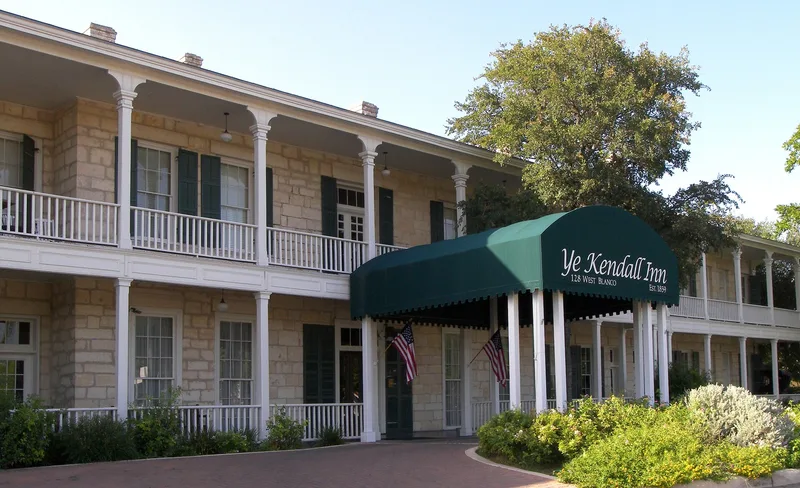
Built in 1859 by Erastus and Sarah Reed, this two-story limestone hotel faces Boerne's main square in the Texas Hill Country. Its central block follows a Greek Revival domestic plan, and narrow wings added in 1878 by Dallas businessmen J. C. Rountree and W. L. Wadsworth repeat the same style across a 160-foot front. Double galleries with chamfered posts give every room access to the south-facing front. The inn sat at the halfway point on the San Antonio to Fredericksburg road and served stagecoach travelers, cattlemen and army convoys. Robert E. Lee dined there before resigning his commission, and the Army's experimental camels were staked out front. Henry C. King, a later owner, became a state senator and editor of the San Antonio Express, and the hotel was promoted as a health resort. It is listed as one of the few surviving 19th-century resort hotels in Texas and an unusually large vernacular Greek Revival building.
Significance in brief: It is one of the few remaining 19th-century resort hotels in Texas and an unusual example of vernacular Greek Revival applied to a large building. It is also tied to early Texas travel and commerce, including visits by Robert E. Lee and a stopover of the Army's experimental camel corps. Later owner Henry C. King was a state senator and newspaper editor.
Machine-generated summary. This summary was generated by a language model from the official nomination document and has not been reviewed line by line by an editor. It may contain errors. Check the source document before relying on any detail. Source: nomination document (PDF) · National Archives catalog entry. NRHP reference 76002045, listed June 29, 1976. Summary generated October 2026 (model claude-sonnet-5-5, prompt v1.0-2026-10-29, confidence high).
Key facts
| Address | Off U.S. 87, Boerne |
|---|---|
| County | Kendall County |
| Listed | June 29, 1976 |
| Reference number | 76002045 |
| Resource type | Building |
| Period of significance | 1859 - 1878 |
| Architect / builder | Erastus Reed and J. C. Rountree and W. L. Wadsworth |
| Architectural style | Greek Revival (vernacular) |
| Areas of significance | Transportation, Politics/Government, Architecture |
| Level of significance | State |
| Status (as stated in the nomination) | Described as in excellent condition and unaltered, but closed by its owner pending restoration of the galleries and guest rooms; extensive structural work was needed on the galleries. |
| Acreage | 2 |
| Coordinates | 29.79413, -98.73362 (NPS GIS) |
What listing means for this property
For an income-producing building, listing (individually or as a contributing building in a district) is the gateway to the 20% federal rehabilitation tax credit on qualified rehabilitation costs, often stackable with state credits. Work claiming the credit must follow the Secretary of the Interior's Standards and be approved in advance.
Listing does not restrict a private owner acting without federal money or permits; where federal funding or licensing is involved, Section 106 review applies.
Noted as vacant in the nomination. Nomination documents can be decades old; current status may differ. If you are considering buying an empty listed property, read the due-diligence checklist.
General information, not legal or tax advice. Rules change; confirm with your State Historic Preservation Office or a qualified adviser.
Sources and further reading
- National Park Service, National Register of Historic Places database (snapshot May 2026), reference 76002045.
- Nomination form (PDF, National Archives) — catalog entry
- Wikipedia article (used for cross-checking only; text not reproduced here)
- Wikidata Q6388915
- This listing as JSON
Last updated October 2026. Found an error? See the editorial policy for how to report it.